The Horseman by JSKY
Explore Mondoir Studio
Medium: Oil on canvas
Dimensions: 60 x 100 cm
Year: 2022
Enquire directly with the artist about this artwork.
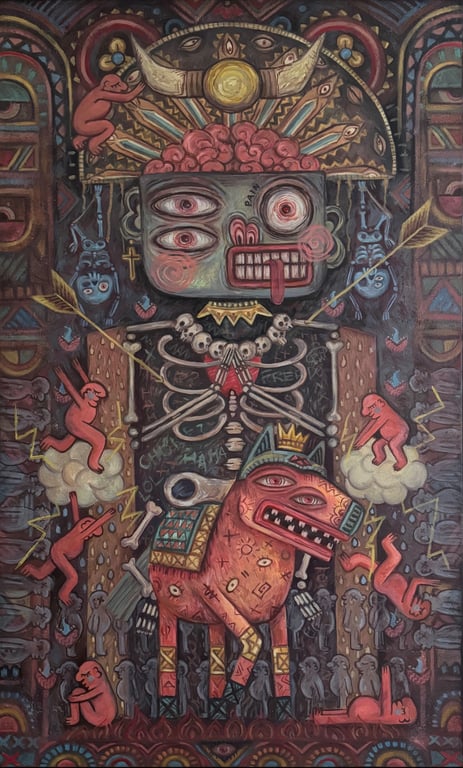
The Horseman enters the world of humans when blood is spilled without measure—when people wage endless wars, killing not for defense, but for greed. When the world of Yav forgets Prav—when the laws of honor, ancient rites, and reverence for ancestral spirits are neglected, and people begin to mock the sacred. When the shadow of Nav falls upon the sun—during rare celestial signs (eclipses, blood moons, or a “sun without rays” during storms), the old legends say that the Horseman spares neither warriors nor peasants. Yet, sometimes his wrath could be averted through the ancient ritual known as “Feeding the Nav Horse.” On the night marking the change of seasons—most often before Kupala Night or Grandfather’s Night—villagers would gather at the outskirts, near a swamp or an ancient burial mound. They would spread a black cloth on the ground and place on it: • three black breads baked without salt, • the bones of a rooster boiled in milk, • a cup of mead with a sprig of wormwood submerged in it. The village elder, dressed in a coat turned inside out, would walk the circle clockwise, murmuring incantations to plead with the Horseman to turn away war and plague from the village, taking only a symbolic offering instead of the people. After the ritual, the bread and bones were thrown into the swamp, the cup of mead poured onto the ground, and the black cloth left behind. According to tradition, the Horseman’s horse would descend from Nav during the night to claim the offering. If in the morning the cloth was found torn and muddied, it was considered a good omen—the Horseman had accepted the offering, and the village would survive. But if the offering remained untouched, the villagers prepared for the worst, for it was believed that the Horseman was already on his way.
Why collect this work?
A side-facing red horse anchors the lower field while a frontal skeletal figure rises above it, setting restless movement against a severe, altar-like hierarchy.
- The artist profile reports training in monumental painting and interior design. That background is relevant here because the crowded narrative is organized through nested borders, bilateral accents and a strong central axis, rather than dispersed as an open scene.
- In the photograph, eyes recur across the horse, the large head and surrounding creatures, while small red bodies fight, climb and tumble at different scales. This multiplication makes violence appear embedded throughout the pictured world, not attributable to one figure alone.
- The documented oil-on-canvas medium can support overlapping opaque forms and sustained tonal modelling. Here, dark outlines keep tightly packed motifs distinct, though the photograph cannot establish the canvas surface or exact colours.
- The catalogue account associates the Horseman with war and an appeasement ritual. Seen beside that narrative, the painting is especially useful for considering how images impose ceremonial order on collective destruction without resolving it.
About the Artist
JSKY
JSKY is an artist on Mondoir Studio. Artistic discipline: Painting. Based in RU.
Nationality: Russian
My art is driven by a desire to create moments of curiosity and emotional warmth.