Wo der Blick nicht endet (Where the Gaze Does Not End) by ELIZA Leopold
Explore Mondoir Studio
Medium: Acrylic on canvas
Dimensions: 100 x 80 cm
Year: 2026
Price: $2300.00 USD
Status: available
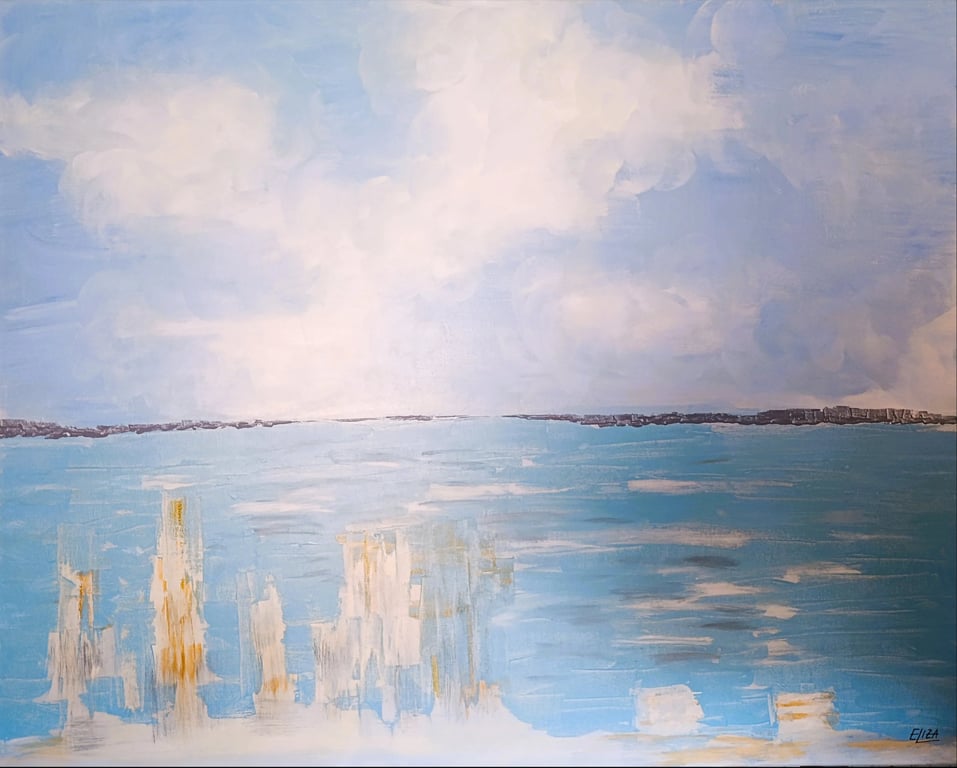
Wo der Blick nicht endet (Where the Gaze Does Not End) Wo der Blick nicht endet opens onto an expansive seascape suspended between the physical landscape and the inner world of human imagination. Soft blues, whites and greys merge across sky and water, dissolving their boundaries into an atmosphere of distance and possibility. A dark, interrupted horizon offers orientation, yet opens at the centre, where the distinction between what can be seen and what can only be imagined begins to disappear. Delicate vertical forms rise from the foreground, some touched with gold. They may suggest reflections, distant architecture, harbour structures or fragments of memory. Their ambiguity introduces a human presence without depicting a figure. The sea becomes more than a landscape. It is a space of longing, where the viewer's gaze travels beyond the visible horizon towards something that cannot be named or possessed. Part of ELIZA Leopold's Interpretationen des Lebens cycle, the painting explores the limits of perception and the human desire to imagine what lies beyond them. “The horizon limits what we can see — but not what we can imagine.” Original acrylic painting on canvas · 2026 · 100 × 80 cm · Unique artwork · ELIZA Leopold · Master Edition 3.0 · Work No. 021
Why collect this work?
A low, interrupted horizon gives this seascape its tension. It establishes distance, then nearly disappears into the pale central passage, making the boundary between water and sky less secure than the landscape format first suggests.
- Leopold says she uses painting to keep questions open rather than illustrate answers. Here, that intention is supported by forms that remain poised between recognizable scenery and abstraction.
- In the photograph, cloud-like masses dominate the upper field, while pale vertical marks rise from the lower edge. These marks could register as reflections, structures, or interruptions to spatial depth.
- Catalogue metadata identifies acrylic on canvas. Its broad fields and sharper passages support contrasting degrees of definition, although the photograph cannot establish paint thickness, layering, or surface texture.
- The painting provides a focused case for considering how contemporary landscape can retain a horizon and recognizable water while withholding a stable account of what occupies the foreground.
About the Artist
ELIZA Leopold
ELIZA Leopold is an artist on Mondoir Studio. Artistic discipline: painting. Based in Stadtilm, DE.
Nationality: German
My work begins with questions. What do we see before we understand? What remains when boundaries disappear?