Was das Meer trägt (What the Sea Carries) by ELIZA Leopold
Explore Mondoir Studio
Medium: Acrylic on canvas
Dimensions: 90 x 60 cm
Year: 2026
Price: $1850.00 USD
Status: available
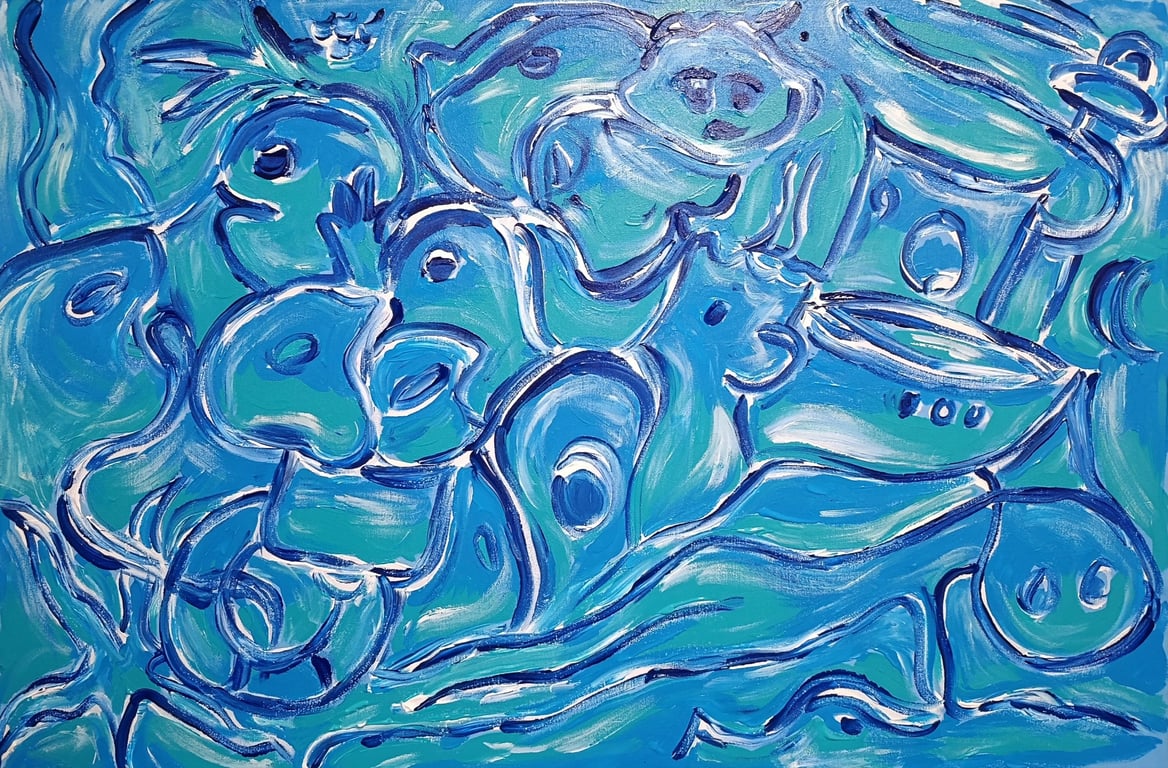
Was das Meer trägt (What the Sea Carries) Was das Meer trägt transforms the sea into a living archive of human existence, memory and history. Within a densely layered world of blues and turquoise, faces, bodies, fish, boats and ambiguous creatures overlap and merge. Nothing exists in isolation. Forms seem to emerge from the water only to dissolve into it again, suggesting an endless movement between life, experience and remembrance. The sea appears in all its contradictions: as a source of life, a place of longing, connection and discovery, but also as a space of danger, displacement and loss. The boat becomes a particularly ambiguous symbol. It may represent travel, trade, exploration or leisure, but equally escape, war, conquest or the hope of reaching another shore. Rather than depicting a specific historical event, the painting brings together countless possible stories. Joy and fear, arrival and disappearance, life and death coexist within the same pictorial space. Part of ELIZA Leopold's Interpretationen des Lebens cycle, the work reflects on the idea that places can preserve human experience long after individual stories have faded. “The sea carries life. And the memory of those it no longer carries.” Original acrylic painting on canvas · 2026 · 90 × 60 cm · Unique artwork · ELIZA Leopold · Master Edition 3.0 · Work No. 029
Why collect this work?
Compressed contours make sea, vessel, faces, and animal-like forms share one unstable field, presenting maritime imagery as a crowded structure of memory rather than a fixed scene.
- In her supplied statement, Leopold describes seeking moments when familiar forms become ambiguous. Here, that intention is supported by motifs that remain recognizable while merging with adjacent bodies and currents.
- In the photograph, cobalt and white contours divide the turquoise field, yet boundaries double as waves, limbs, hulls, or mouths. A boat-like form at right provides only a temporary point of orientation.
- The catalogue records acrylic on canvas, dated 2026. The medium accommodates the opaque overlaps and abrupt contour changes seen here, allowing one shape to interrupt or absorb another.
- Within a display about the sea as both environment and human record, this painting could complicate easy distinctions between natural and human histories by compressing fish, faces, transport, and water into one current.
About the Artist
ELIZA Leopold
ELIZA Leopold is an artist on Mondoir Studio. Artistic discipline: painting. Based in Stadtilm, DE.
Nationality: German
My work begins with questions. What do we see before we understand? What remains when boundaries disappear?