The Àdàmú Òrìsà play by SAMUEL OPEYEMI
Explore Mondoir Studio
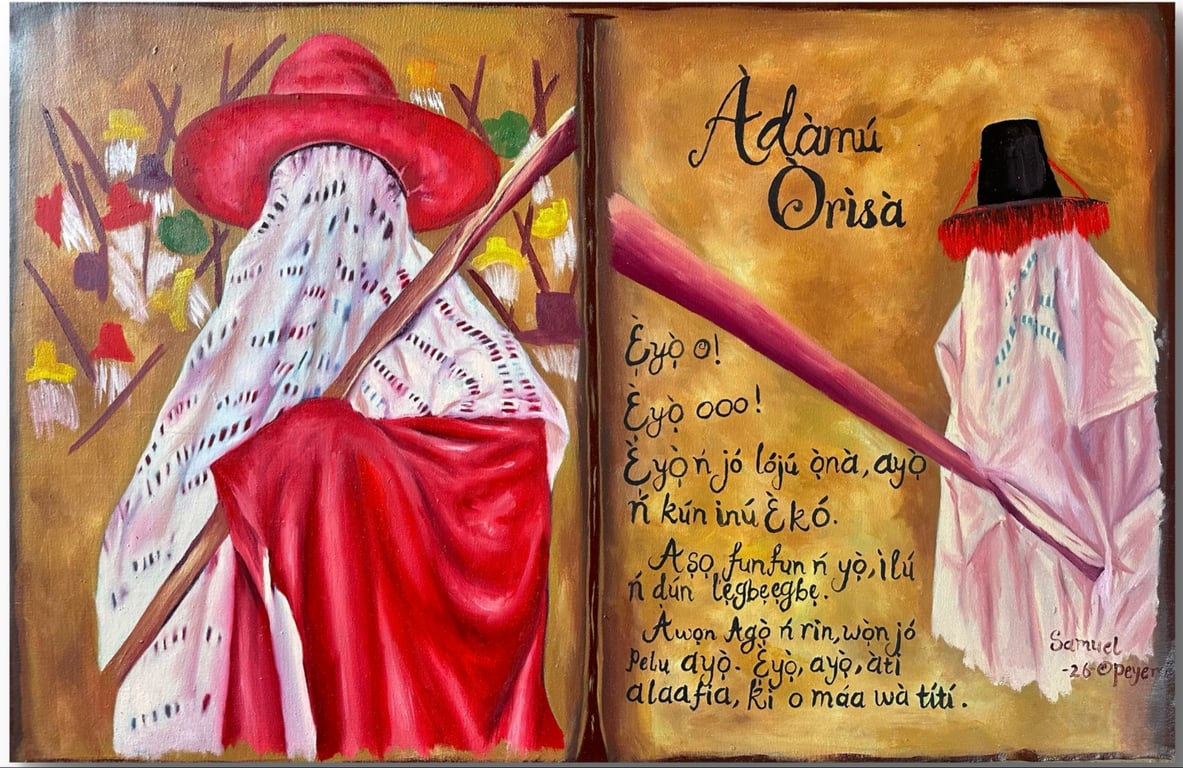
Medium: Oil and acrylic on canvas
Dimensions: 36 x 24 in
Year: 2026
Price: $1200.00 USD
Status: available
Growing up, as a child in Lagos, one of the most beautiful experiences I had was the Adamu Orisà play [Eyo festival], the colors the dances ,the extremely tall masquerades,the attires, the whole activities was never one to forget. The Adamu Orisha Play (EYO festival) is a unique Yoruba cultural event on Lagos Island, Nigeria. White-clad masquerades (Eyo) representing ancestral spirits parade through the streets in flowing robes, veils, and distinctive hats, carrying staffs called opambata. It is held occasionally to honour deceased kings, chiefs, or prominent Lagosians, purify the city, and mark important transitions. It is is considered one of Lagos's highest traditional rites. The Adamu orisha play is a cultural heritage and it should be revered, documented, and preserved, never to be forgotten. Translation of the Yorùbá poem … English translation: Eyo o! Eyo ooo! Eyo is dancing right in the middle of the road; joy fills the heart of Lagos (Èkó). White cloths are shining/rejoicing, the city is resounding with "legbeegbe." The Agos (Eyo masqueraders) are walking; they are dancing with joy. Eyo, joy, and peace - may they continue forever.
Why collect this work?
The painting divides festival memory into image and inscription, then uses long diagonal staffs to prevent the two registers from settling into a simple illustration-and-caption relationship.
- Opeyemi describes the canvas as a diary for personal memory and Yoruba cultural documentation. Here, recollection is made public through figures, handwritten language, and the naming of the Àdàmú Òrìsà play.
- The photograph shows two white-veiled masqueraders separated by a dark vertical band. Their contrasting red and black hats anchor each side, while staffs cut across the warm ground and direct attention between procession and poem.
- Catalogue metadata identifies oil and acrylic on canvas. That combination permits broad opaque passages alongside finer written lines, allowing painted costume and Yoruba text to occupy the same surface without becoming equivalent forms.
- The artist presents the work as cultural preservation, recalling an Eyo festival experienced in childhood. Encountering the painting beside the supplied translation makes language itself central: the Yoruba inscription carries rhythm, place, and continuity that translation can clarify but not replace.
About the Artist
SAMUEL OPEYEMI
SAMUEL OPEYEMI is an artist on Mondoir Studio. Artistic discipline: painting. Based in Lagos, NG.
Nationality: Nigerian
My practice is rooted in painting, personal memory, and the documentation of cultural identity.