Fela Anikulapo Kuti by SAMUEL OPEYEMI
Explore Mondoir Studio
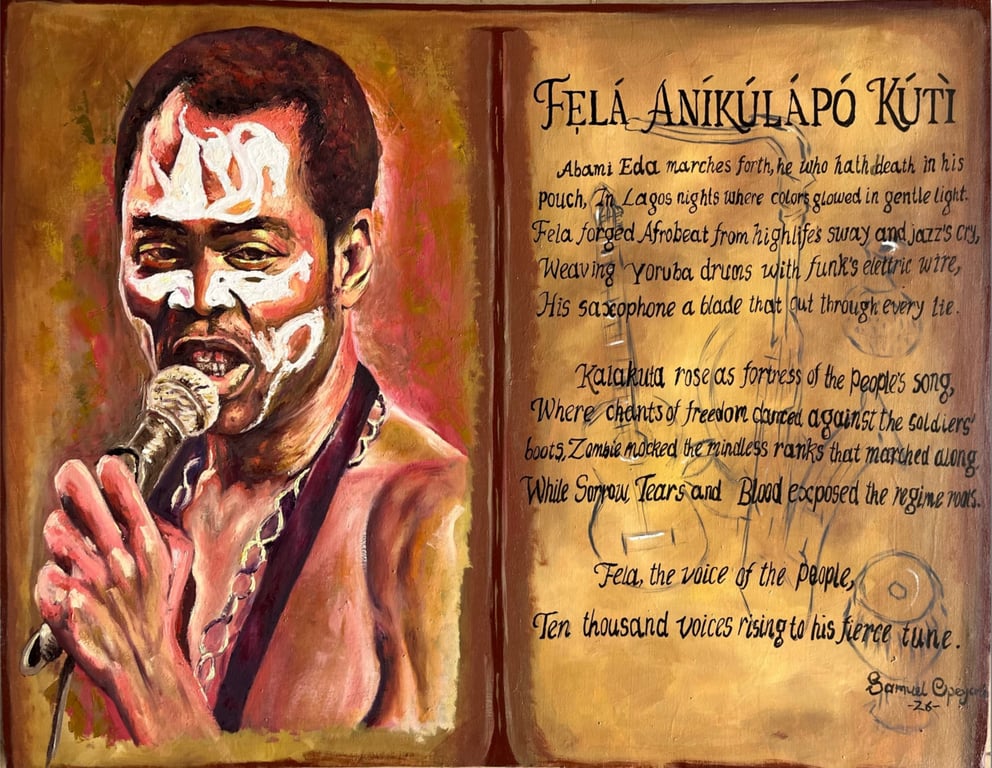
Medium: Oil and acrylic on canvas
Dimensions: 36 x 27 in
Year: 2026
Price: $1500.00 USD
Status: available
Fela Anikulapo Kuti (15 October 1938 - 2 August 1997) was a Yoruba Nigerian multi-instrumentalist, bandleader, composer, and the principal innovator of Afrobeat. Afrobeat fused traditional Yoruba rhythms and highlife with American jazz, funk, soul, and blues. It featured extended improvisational grooves, powerful horn sections, complex percussion , drummer call-and-response vocals, and Fela's distinctive pidgin English singing, saxophone, keyboard, and trumpet playing. He opened the Afrika Shrine nightclub in Lagos, and established the Kalakuta Republic, a self-declared independent communal compound that served as home, recording studio, and political statement. He released dozens of albums (roughly 50 in total), including landmark works such as Shakara (1972), Roforofo Fight (1972), Expensive Shit (1975), Zombie (1976/77), Sorrow, Tears and Blood (1977), Coffin for Head of State (1981), and Beasts of No Nation (1989). Songs openly attacked military dictatorship, corruption, police brutality, and neo-colonialism. Fela's outspoken criticism made him a constant target of successive Nigerian military governments. He was arrested approximately 200 times. The most notorious incident was the 1977 military raid on Kalakuta Republic, during which the compound was burned, residents were beaten and assaulted, and his mother was thrwn from a window, she died the following year from her injuries. Fela responded with songs such as "Coffin for Head of State" and "Unknown Soldier." Despite repeated imprisonment and declining health, he continued performing and recording. He died on 2 August 1997 in Lagos, an estimated one million people attended his funeral procession. Fela's influence remains enormous as Afrobeat shaped generations of African and global music, Fela brought his story to international stages, and he is remembered as both a musical revolutionary and a fearless critic of authoritarianism and injustice in postcolonial Africa. Fela's legacy remains an historical legend and should be revered, documented, never to be forgotten.
Why collect this work?
A book-like split between painted performance and handwritten tribute turns Fela Kuti’s likeness into a commemorative record, balancing the immediacy of song with the slower work of historical narration.
- Opeyemi calls the canvas his diary and states that painting and writing preserve cultural identity. That intention helps explain why this portrait incorporates biography rather than relying on likeness alone.
- The photograph shows Kuti gripping a microphone on the left, while his name and lines about Afrobeat, Kalakuta, resistance, and collective voice fill the right. Sharp cream highlights fragment his face and hand, giving the performance greater visual force than the subdued ochre ground.
- The catalogue identifies oil and acrylic on canvas, dated 2026. Opaque painted marks support both bodily modelling and calligraphic lettering, while the dark central band and perimeter create the appearance of an open, worn page.
- The work is particularly relevant to accounts of how portraiture can transmit musical history. Image and text make commemoration visibly selective, presenting Kuti through performance, named songs, and political opposition.
About the Artist
SAMUEL OPEYEMI
SAMUEL OPEYEMI is an artist on Mondoir Studio. Artistic discipline: painting. Based in Lagos, NG.
Nationality: Nigerian
My practice is rooted in painting, personal memory, and the documentation of cultural identity.