DÀDA ÀWÚRÚ by SAMUEL OPEYEMI
Explore Mondoir Studio
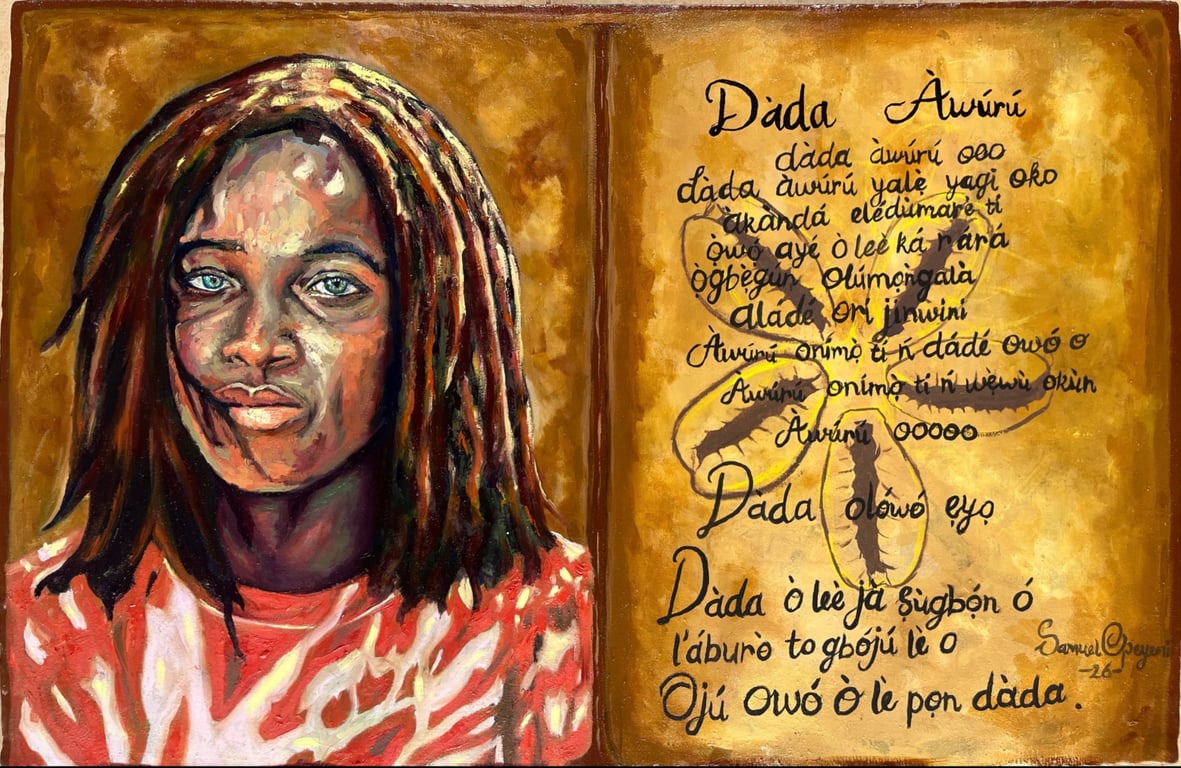
Medium: Oil and Acrylic on canvas
Dimensions: 36 x 24 in
Year: 2026
Price: $1200.00 USD
Status: available
In Yoruba culture, a child born with natural dreadlocks or matted hair is simply named Dada. Children born as Dada are revered as special gifts from the Orisha (deities) and are believed to bring spiritual protection, prosperity, and wealth—likened to cowrie shells-to their families. Cultural taboos strictly forbid combing or cutting their hair casually; non-family members who touch the hair are traditionally required to offer a gift or money to the child to maintain harmony and health. .....Translation of Yorùbá poem….. (Oríkì)-(eulogy )of Dàda Dàda Àwúrú ooo DàdaÀwúrú, the fierce one who tears the ground and breaks the trees of the farm Special creation of Olódumarè (God) Whom the hands of the world cannot grasp or contain at all The invincible one, the master of deep knowledge/secrets The crowned one with a sparkling/glittering head Awúrú, the knowledgeable one who wears a crown of money Àwúrú, the knowledgeable one who wears a garment of beads/ coral Àwúrú ooooo He carries a full/big crown of money into the market The one whom all his family pampers and cherishes The crowned one of money is the one we know as Dada Dàda, the wealthy one with cowries (money) Dàda cannot fight, but he has a younger sibling who is brave and bold, Money can never be (scarce/hard) for Dàda Dàda with the sparkling head, the wealthy one with cowries.
Why collect this work?
A book-like central division places a frontal portrait beside handwritten praise poetry, making language structurally equal to likeness rather than a secondary explanation.
- Opeyemi calls his canvas a diary and describes painting as a means of preserving Yoruba language and cultural memory. In this work, that intention takes the form of paired image and inscription.
- The photograph shows the figure confined largely to the left panel, while looping black script occupies the ochre field at right. The catalogue identifies this text as an oríkì for Dàda, a child born with naturally matted hair.
- The documented oil and acrylic support two visual registers: layered, angular colour models the face and clothing, while dark linear marks give the writing a force comparable to the portrait.
- The work is significant for treating an indigenous praise form as central visual material. It enables direct consideration of how portraiture can represent cultural identity through naming and spoken tradition as well as appearance.
About the Artist
SAMUEL OPEYEMI
SAMUEL OPEYEMI is an artist on Mondoir Studio. Artistic discipline: painting. Based in Lagos, NG.
Nationality: Nigerian
My practice is rooted in painting, personal memory, and the documentation of cultural identity.