The knight at the father's feet by John Sergio Vélez
Explore Mondoir Studio
Medium: Oil on canvas
Dimensions: 115 x 150 cm
Year: 2026
Price: $4500.00 USD
Status: available
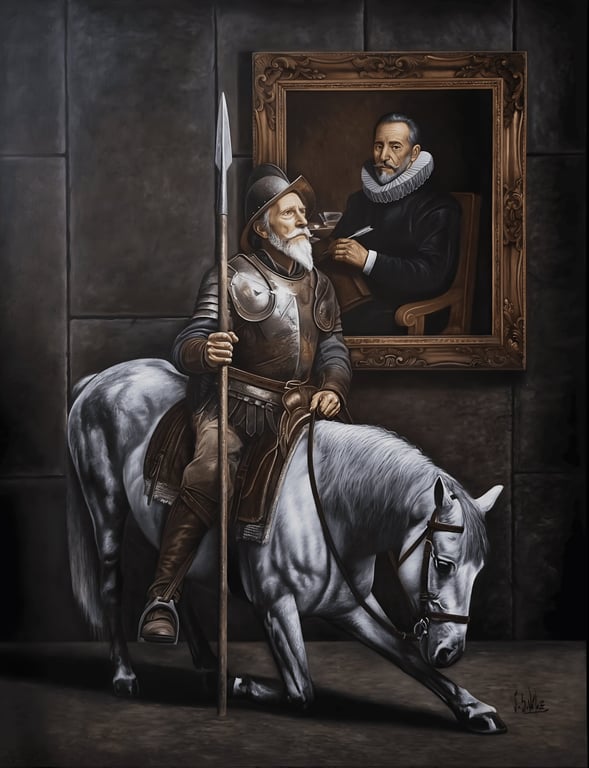
After traversing roads, facing giants, and championing causes the world deemed impossible, the knight returns to his father. At the feet of Miguel de Cervantes Saavedra—who once breathed life into him through imagination—Don Quixote appears not as a victor claiming glory, but as a son returning from a long journey to present the fruits of his existence. His armor, his wounds, his battles, and his inseparable Rocinante bear witness to a life devoted to ideals that often seemed absurd in the eyes of the world. Freedom, justice, and the struggle for what is worth defending become the true harvest of his odyssey. Cervantes remains within the frame, in the space where the character was born. Don Quixote, however, has transcended those boundaries and taken on a life of his own. A silent dialogue passes between them: the creator gazes upon his creation, and the latter returns to show him what he did with the life he was granted. The scene is not one of defeat. Rocinante’s stance and the knight’s bearing express respect, gratitude, and humility toward the one who gave him life. Don Quixote does not return to ask forgiveness for his failures or to claim glory for his victories; he returns to bear witness to having lived true to his convictions. Perhaps that is his true victory.
Why collect this work?
A frame divides creator from creation: Cervantes remains a picture within the painting, while Don Quixote and Rocinante occupy its surrounding world. This spatial distinction makes authorship, rather than adventure, the work’s central subject.
- Vélez states that his practice examines reality, perception, memory, and human experience. Here, those concerns focus on the imagined independence of a literary character from his author.
- In the supplied photograph, the upright lance and rectangular frame establish firm verticals, while Rocinante’s neck and foreleg descend diagonally. The artist describes this lowered posture as respect and humility, although it may also suggest exhaustion or submission.
- Catalogued as oil on canvas from 2026, the painting uses gradual tonal modelling and concentrated highlights to distinguish armour, horse, and faces from the dark interior. Oil supports these smooth transitions between illumination and shadow.
- The picture-within-a-picture turns literary adaptation into a visible problem: does the character remain contained by Cervantes, or exceed him? That unresolved question gives the historical scene its contemporary interpretive force.
About the Artist
John Sergio Vélez
John Sergio Vélez is an artist on Mondoir Studio. Artistic discipline: painting. Based in Medellin, CO.
Nationality: Colombian
My artistic work stems from an exploration of the human condition, emotions, and the relationship between reality and perception.