Kayapo HC16 by Fede Bianchi
Explore Mondoir Studio
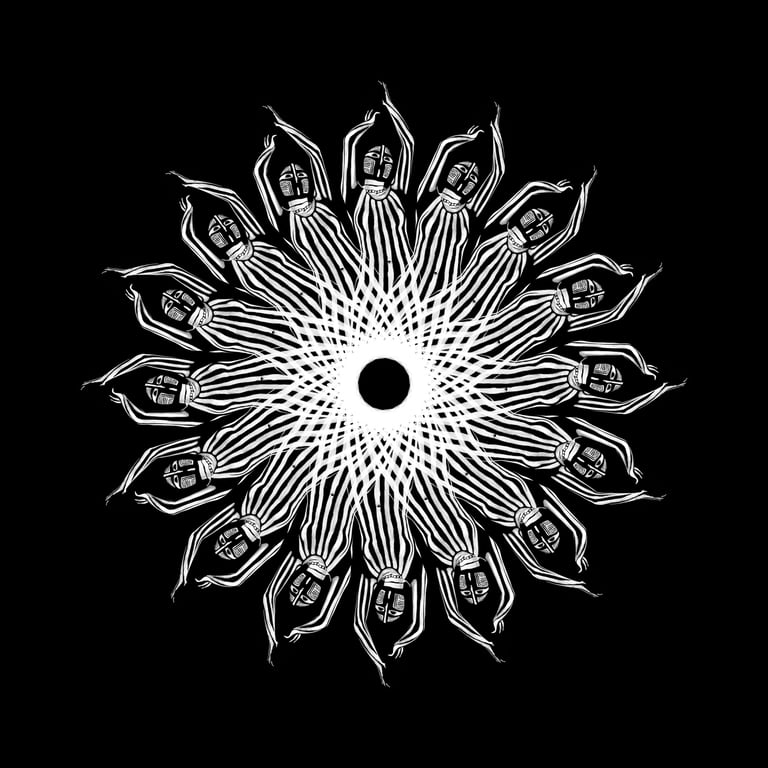
Medium: Archival pigment print on Metallic Paper
Dimensions: 60.96 x 60.96 cm
Edition production year: 2025
Edition of 15
Price: $2500.00 USD
Status: available
Kayapo HC16 from the series 💢 Deprived 💢 Inspired by pre-Columbus Indigenous body art, this work tries to bring awareness of the extreme deprivation the original peoples have been suffering for the last centuries. Their glowing energy transcends the invisible subjects through the infinite and universal space of the body mandalas in an attempt to rescue the brightness and fluorescence of these civilizations. Technique: Hand-painted UV-reactive body paint is applied directly onto the model using patterns inspired by Indigenous/pre-Columbian body art. The image is photographed in a dark studio under controlled UV/blacklight so the pigment fluoresces while the human figure recedes into near-invisibility. In post-production, I deepen the surrounding blacks, remove any ambient light spill, and preserve the authentic glow of the paint. For the “body mandala” compositions, multiple photographs of the painted body are then composited—with sacred geometry rotations—to create a symmetrical, radiating structure where the pattern becomes both presence and message. Story: Since Gonzalo Pizarro started his search for “El Dorado” or “City of Gold” in 1541, the whole Amazon has been marked with brutality, slavery, violence, disease, genocide, deforestation, contamination, population declines of animals and native peoples and the deprivation of their lands. From the thousands of tribes that once lived there at the time the europeans colonists arrived a few survived to this date. On average, it is estimated that one tribe became extinct every year over the last century. Today, 60% of the Amazon is in Brazil’s territory. There are about 305 tribes living in Brazil today totaling around 900,000 people that are constantly under survival thread as more industrialization plans are developed. This is a battle that more than 200 organizations are fighting on the streets and at government institutions. I’m highlighting in this artwork Kayapo tribe.
Why collect this work?
A ring of repeated bodies turns the figure into a precise radial system, while the central black void interrupts any easy image of unity.
- Bianchi describes his Body Mandalas as using the human figure as a matrix for geometry. Here, that approach produces collective form but also suppresses individual difference.
- In the photograph, striped torsos converge into a dense white lattice, while bent arms articulate the outer edge. Repeated faces remain legible, holding the image between human assembly and abstract emblem.
- The catalogue documents UV-reactive body paint, blacklight photography, and digitally rotated composites. These methods allow bodily outlines to recede as painted lines become the work’s dominant structure; metallic paper may further heighten shifts between brightness and black.
- The title identifies the Kayapo, and the artist states that the series addresses Indigenous deprivation. Encountering this work means testing that political aim against its visual method: symmetry creates forceful solidarity, yet repetition can also reduce a particular people to a generalized pattern.
About the Artist
Fede Bianchi
Fede Bianchi is an artist on Mondoir Studio. Artistic discipline: photography. Based in Miami, United States.
Nationality: Argentine
My practice navigates the space between symmetry and chaos, exploring how order, emotion, and meaning emerge through visual experience.