Woman on the Tower. Code :AC0034HADHF02 by Alessandro Cardamone
Explore Mondoir Studio
Medium: Stampa su tela
Dimensions: 100 x 120 cm
Edition production year: 2011
Price: $13904.00 USD
Status: available
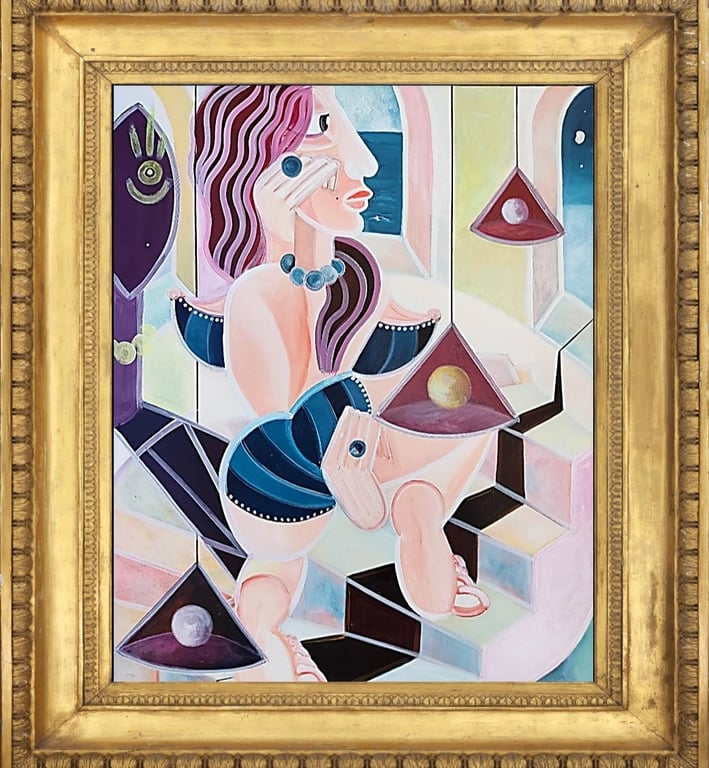
Hong Art Museum Limited Edition Digital Reproduction on canvas using the Giggle technique . Signed and numbered by the artist, with a certificate of authenticity Digital print with hand-finished details (design elements or color highlights) Limited edition of 2 out of 10, scale 1:1, using the Gigleec technique on 380g 100% cotton canvas, with the artist’s description and signature on the reverse of the work AC0034HA from 2011, created in Nuglar, Switzerland, and exhibited at the Hong Art Museum in Chongqing, China, in 2023/2024 Title: Woman in the Tower Code: AC0034HA Year: 2011, Switzerland Artist: Alessandro Cardamone Technique: Acrylic on canvas Style: Contemporary Cubism / Symbolic Surrealism ________________________________________ Formal Analysis Woman in the Tower (ALECARD 0034HL) marks a significant evolution in Alessandro Cardamone’s neo-cubist language, where geometric construction intertwines with a strong narrative and symbolic dimension. The female figure, placed in a central vertical position, is enclosed within an architectural structure reminiscent of a tower or a cloistered interior. Broken lines and overlapping volumes define an ascending verticality, accentuated by chromatic planes alternating ochre, deep blue, earthy reds, and pearly tones. The composition appears built in layers, as if the woman’s body were one with the architectural framework surrounding her — a unity of matter, light, and spirit. The static, almost hieratic posture is balanced by an inner rhythm of diagonals and curves suggesting an upward tension. The stylized, fragmented face retains an expression of meditative stillness. Cardamone’s use of acrylic allows for transparency and overlapping effects that transform the pictorial surface into a mental rather than physical space. ________________________________________ Symbolism and Interpretation The subject of the Woman in the Tower draws upon an archaic and archetypal dimension. The tower, a symbol of both isolation and elevation, represents here the inner space of consciousness — the place where the female figure withdraws in search of transformation and awareness. The woman is not a prisoner but a guardian of her silence: her gathered posture and the surrounding verticality evoke a process of ascension and rebirth. Her body, integrated with the architecture, becomes a metaphor for the fusion between identity and structure, between the individual and the spirit. The fragmented face and overlapping planes allude to the complexity of feminine identity — multiplicity, introspection, and resilience. The geometric windows and luminous apertures crossing the composition symbolize the dialogue between inner and outer worlds, between creative solitude and communication with reality. ________________________________________ Influences The work reveals a dialogue with both the cubist tradition and the early twentieth-century symbolist painting. The influence of Picasso and Gris emerges in the volumetric construction and the use of line as a structural element. However, Cardamone introduces a more spiritual dimension, in which Cubism becomes a language of interiority. Echoes of Paul Klee can be perceived in the architectural sensitivity of the composition and in the transparency of the chromatic fields, while references to Modigliani appear in the verticality of the body and the expressive tension of the face. The result is a lyrical and contemporary neo-cubism, where fragmentation gives way to poetic synthesis. ________________________________________ Critical Evaluation Woman in the Tower represents one of the moments of greatest poetic and conceptual maturity in Cardamone’s artistic path. The artist achieves a perfect balance between formal construction and symbolic depth, offering a vision in which the figure becomes architecture, and architecture becomes body. Strengths: • Solid, coherent compositional structure based on meditative verticality. • Color as a vehicle of energy and introspection. • Harmonious integration of figure and space. • Symbolic interpretation of solitude as a creative dimension. Distinctive elements compared to other works in the cycle: • Greater monumentality and architectural sense of form. • Psychological depth achieved through synthesis rather than description. • A more contemplative and spiritual tone, close to sacred painting. Cardamone succeeds in transforming an apparently silent scene into an icon of inner strength, fusing modern language with ancient myth. ________________________________________ Conclusion With Woman in the Tower (ALECARD 0034HL), Alessandro Cardamone offers a powerful reflection on the human condition and on feminine identity as a place of guardianship and regeneration. Although rooted in neo-cubist language, the work transcends form to reach a symbolic and universal expression. The tower becomes a space of the soul, the woman its vital center. Through light, color, and controlled fragmentation, Cardamone invites the viewer into an inner dialogue — between enclosure and openness, between form and spirit. The work captivates with its visual richness and invites a layered reading, both aesthetic and introspective. ________________________________________ Curatorial Note This painting belongs to the cycle dedicated to the female figure as an archetype of identity and transformation. Woman in the Tower represents one of the highest points in Cardamone’s neo-cubist language, where formal analysis merges with profound poetic introspection. Ideal for exhibitions exploring the relationship between architecture and the human figure, the spirituality of form, and the contemporary reinterpretation of the cubist vocabulary. The work was part of the international collection of the Hong Art Museum in Chongqing (China), exhibited from November 2023 to March 2024. ________________________________________ Exhibition Note This artwork, exhibited in several European countries, was part of the collection hosted by the Hong Art Museum in Chongqing, China, from November 2023 to March 2024.
Why collect this work?
The figure is not simply fragmented but recalibrated: enlarged hands, compressed limbs and shifting viewpoints make bodily proportion yield to the tower’s visual order.
- Cardamone calls his practice “Modern Neo-Cubism.” That self-description is useful here because recognisable anatomy persists while conventional proportion and continuous space are deliberately withheld.
- In the photograph, the profile dominates the upper half, while bent legs descend through pale steps below. Circular jewels and orb-filled triangles punctuate this downward movement, linking bodily adornment to the surrounding architecture.
- Catalogue metadata identifies an editioned digital print on cotton canvas, with hand-finished details, derived from a 2011 acrylic composition. Reproduction can preserve the design’s hard boundaries and repeated motifs, but this image does not reveal which passages were finished by hand.
- The work supports comparison between portraiture and architectural fantasy: face, staircase, windows and ornaments obey incompatible scales, so identity is constructed through spatial discontinuity rather than likeness alone.
About the Artist
Alessandro Cardamone
Alessandro Cardamone is an artist on Mondoir Studio. Artistic discipline: painting. Based in Ottiglio, IT.
Nationality: Italian
The Artistic Identity and Technique Alessandro Cardamone’s artistic practice is rooted in a rigorous, independent visual philosophy that he defines...