Woman in the Beach Code: AC007B by Alessandro Cardamone
Explore Mondoir Studio
Medium: Acrylic on Canvas
Dimensions: 110 x 85 cm
Year: 2001
Price: $68500.00 USD
Status: available
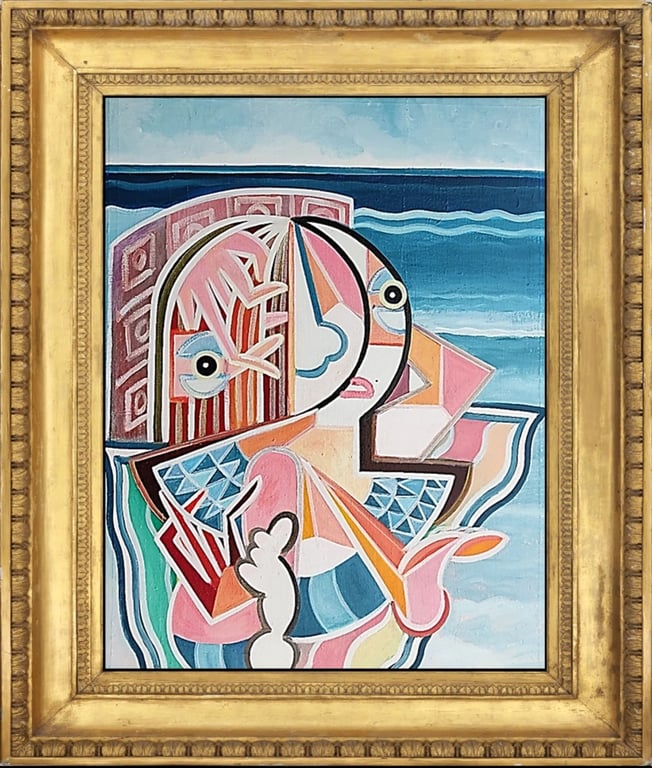
Title: Woman on the Beach Code: AC007B Year: 2001, Switzerland Artist: Alessandro Cardamone Technique: Acrylic on canvas Style: Neo-Cubism / Contemporary Abstract Figuration ________________________________________ Formal Analysis Woman on the Beach (ALECARD007B) represents one of the earliest explorations of the female figure immersed in a luminous and contemplative natural environment—a theme that would become central to Alessandro Cardamone’s artistic vision. Created in 2001, this work marks the transition from the structural introspection of his earlier paintings toward a greater chromatic and lyrical openness. The composition is based on a geometry that is carefully balanced yet not rigid: the forms unfold in a rhythm of curved and diagonal planes suggesting the expanse of the sea, the horizon line, and the meditative posture of the figure. The woman, seated or gathered in a moment of stillness, is constructed through segments and volumes that merge into light, losing defined contours to take on an atmospheric consistency. The palette, dominated by sandy tones, sunlit yellows, deep blues, and warm ochres, conveys the warmth and silence of the seaside landscape. Light becomes a constructive element: it does not merely illuminate, but models, dissolves, and transforms forms into chromatic vibrations. Already in this phase, Cardamone demonstrates a remarkable mastery of the Neo-Cubist language—capable of uniting structural fragmentation with emotional and meditative sensitivity. ________________________________________ Symbolism and Interpretation Woman on the Beach is a reflection on the human condition in harmony with nature. The female figure, captured in a moment of quiet and contemplation, becomes a symbol of introspection and fusion with the surrounding environment. The sea, suggested by horizontal lines and shimmering light, represents inner movement, the fluidity of consciousness, and the depth of time. The woman, immersed in this boundless space, becomes an image of balance and awareness—a bridge between matter and spirit. Her collected gesture and static posture express a suspension of time, a moment of silence that invites meditation. Cardamone transforms the natural scene into a mental dimension, where the external landscape mirrors an inner state of being. ________________________________________ Influences The work clearly reveals the roots of Cardamone’s language in Synthetic Cubism and European modernist aesthetics. Echoes of Picasso and Gris can be perceived in the geometric construction, while Matisse’s influence emerges in the fluidity of line and the luminosity of the color palette. Furthermore, the sense of equilibrium and stillness recalls Morandi’s painting and De Chirico’s metaphysical atmosphere—reinterpreted here in a lyrical and spiritual key. The attention to the relationship between figure and natural space anticipates the artist’s later explorations, where the woman becomes a universal symbol of harmony and contemplation. ________________________________________ Critical Evaluation Woman on the Beach (ALECARD007B) marks a pivotal stage in the formation of Cardamone’s style. Though part of his early mature period, the work already displays a clear formal and poetic awareness. Strengths: • A synthesis between geometric construction and chromatic lyricism. • Representation of the female figure as a meditative presence. • Color conceived as inner light rather than descriptive tone. • Balance between structural rigor and visual poetry. Distinctive elements: • A warm, sunlit palette foreshadowing the brighter works of the following decade. • Fluid integration between figure and landscape. • Early signs of the contemplative dimension that would define the artist’s mature production. ________________________________________ Conclusion Woman on the Beach (ALECARD007B) is one of the key works for understanding the evolution of Alessandro Cardamone’s language. In it, the female figure becomes a vehicle of balance between body and nature, between outward vision and inner light. The tension between geometry and spirituality, between structure and lyricism, already reveals the direction that would lead the artist toward his great mature canvases. This work is not merely a stylistic exercise but a moment of poetic revelation, in which Neo-Cubism becomes a language of the soul. ________________________________________ Curatorial Note Woman on the Beach (ALECARD007B) belongs to the cycle dedicated to the female figure as a symbol of harmony and fusion with nature. Created in Switzerland in 2001, it represents one of the first affirmations of Cardamone’s personal language—suspended between geometric abstraction and poetic introspection. An ideal work for exhibitions dedicated to contemporary Neo-Cubism and the depiction of the inner landscape, it bears witness to the origin of a visual inquiry that, over the years, has led the artist toward an ever more luminous and spiritual vision of painting. (Critical text written for artistic documentation purposes — Basel, 2025)
Why collect this work?
Nested profiles, fishlike eyes and architectural curves make the beach figure inseparable from her marine setting, while the level horizon steadies continual shifts in recognition.
- Cardamone calls his practice “Modern Neo-Cubism” and identifies the female figure as a recurrent subject. Here, geometric fragmentation complicates the body without making it unreadable.
- In the photograph, a right-facing head contains a smaller profile amid finlike shapes and repeated eyes. Pink and coral diagonals push against horizontal blue water bands, setting bodily motion against the sea’s measured structure.
- The catalogue records acrylic on canvas, made in 2001. Acrylic can support the sharply bounded, opaque colour fields used to separate overlapping planes, though the photograph cannot confirm exact colour or surface texture.
- This painting provides a focused case for examining how figuration survives fragmentation. Face, fish, garment and shoreline exchange visual roles, yet the figure remains present rather than collapsing into complete abstraction.
About the Artist
Alessandro Cardamone
Alessandro Cardamone is an artist on Mondoir Studio. Artistic discipline: painting. Based in Ottiglio, IT.
Nationality: Italian
The Artistic Identity and Technique Alessandro Cardamone’s artistic practice is rooted in a rigorous, independent visual philosophy that he defines...