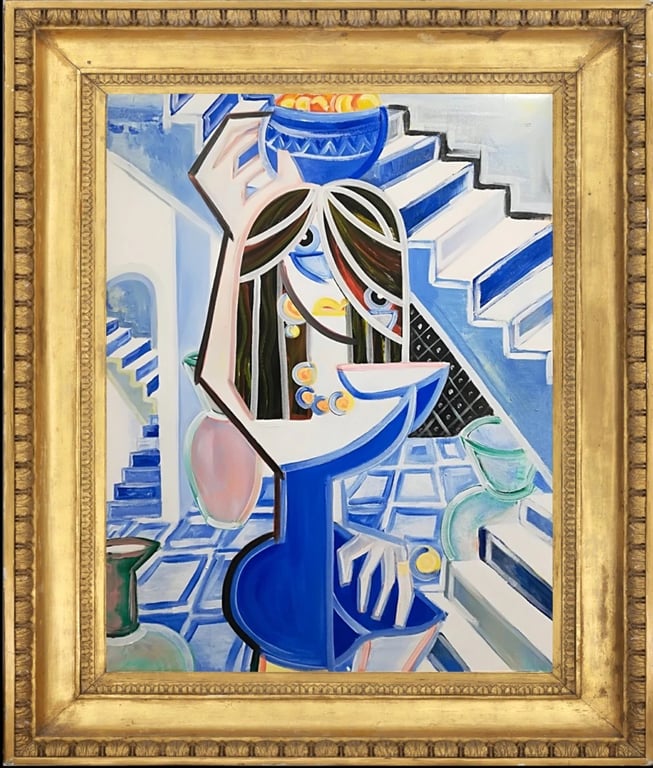
Woman in Terrace Code AC007LD02 by Alessandro Cardamone
Explore Mondoir Studio
Medium: Stampa su tela
Dimensions: 100 x 130 cm
Edition production year: 2004
Price: $4000.00 USD
Status: available
Limitierte Auflage, digitale Reproduktion des Hong Art Museum auf Giggle Canvas Vom Künstler signiert und nummeriert. Mit Echtheitszertifikat. Limitierte Reproduktion von 1/20 Stück, Maßstab 1/1, Gigleec-Technik, auf 100 % Baumwolle, 380 g, matt-Baumwoll-Leinwand, mit Beschreibung, signiert und nummeriert vom Künstler auf der Rückseite wie auf dem Foto. Mit Echtheitszertifikat des Werks AC007L Switzerland 2004 Title: Woman on the Terrace Code: AC007L Year: 2004, Switzerland Artist: Alessandro Cardamone Technique: Acrylic on canvas Style: Neo-Cubism / Contemporary Abstract Figuration ________________________________________ Formal Analysis Woman on the Terrace (ALECARD007L) represents a pivotal stage in Alessandro Cardamone’s pictorial research, situated between the lyrical introspection of his early 2000s works and the luminous openness of his later period. The composition is built upon a balanced geometric structure, dominated by intersecting diagonals and elegant curves. The female figure, portrayed in a moment of outdoor contemplation, is inscribed within a landscape constructed through planes and overlays of light, where every element seems to vibrate in silent harmony. The terrace — an intermediate space between interior and exterior — is rendered through a succession of chromatic planes: golden ochres, ultramarine blues, acidic greens, and pinkish tones that modulate depth and create a sense of visual expansion. The woman, though fragmented according to the logic of Neo-Cubism, retains a fluid and meditative presence: the curve of her body contrasts with the architectural rigidity of the background, generating a dynamic tension that becomes the poetic breath of the entire work. ________________________________________ Symbolism and Interpretation The work is a meditation on thresholds — the moment of transition between inner life and the external world. The “woman on the terrace” does not merely observe the landscape: she contemplates and interiorizes it, transforming it into a state of mind. The terrace, as a symbolic space, represents the boundary between the visible and the invisible, between the intimacy of consciousness and the openness toward infinity. The female body thus becomes a metaphor for harmony between humanity and nature, between thought and perception. The figure’s composed gesture suggests a condition of waiting and reflection, almost a suspended moment in time. Cardamone transforms an everyday vision into a mental scene, where the landscape becomes a projection of inner emotion and light takes on spiritual meaning. ________________________________________ Influences In Woman on the Terrace, one perceives the roots of Synthetic Cubism — particularly the legacy of Picasso and Gris — but reinterpreted through an intimately lyrical sensitivity. The geometric purity merges with a meditative dimension, partly drawn from Matisse’s influence, especially in the use of color as a vehicle of emotional balance. Echoes of Italian Metaphysical painting are present — in the suspension of time and the rarefied spatiality — as well as affinities with the contemplative calm of modern artists such as Paul Klee and Giorgio Morandi. Yet Cardamone’s voice remains distinct: his geometric construction is never cold or analytical, but suffused with humanity and introspection. ________________________________________ Critical Evaluation Woman on the Terrace marks a moment of maturity in Cardamone’s artistic vision. Here, the tension between structure and sentiment resolves into a harmonious balance, where each formal element contributes to an atmosphere of luminous stillness. Strengths: • Harmonious synthesis between figure and architectural space. • Use of color as an emotional and spiritual vehicle. • Ability to transform a quotidian scene into a universal experience. • Refined use of light as both constructive and symbolic element. Distinctive Elements: • More spacious and contemplative composition compared to earlier works. • Greater fusion between figure and environment, reflecting the artist’s mature pictorial language. • Diffused, transparent light that anticipates the works of the following decade. ________________________________________ Conclusion Woman on the Terrace (ALECARD007L) is one of the most representative works of Alessandro Cardamone’s phase of artistic consolidation. In it, the Neo-Cubist language attains a lyrical and spiritual dimension, uniting geometric construction with emotional depth. The female figure becomes a symbol of harmony between inner life and the world, between silence and openness, between thought and light. With this canvas, Cardamone reaffirms his ability to blend formal modernity with visual poetry, fully positioning himself within the European context of contemporary abstract figuration. ________________________________________ Curatorial Note Woman on the Terrace (ALECARD007L) belongs to the cycle dedicated to the female figure as a space of reflection and contemplation. Created in 2004 in Switzerland, it marks a key moment in the evolution of Cardamone’s Neo-Cubist language, bridging his analytical phase and his later, more lyrical and meditative period. An ideal work for exhibitions focused on the relationship between figure and landscape, and on painting as an inner experience, it is considered one of the most balanced and poetic achievements in Alessandro Cardamone’s production. ________________________________________ Exhibition Note This work, exhibited in several European countries, is part of the collection hosted by the Hong Art Museum in Chongqing, China, from November 2023 to March 2024. Critical text written for artistic documentation purposes Basel, 2025.
Why collect this work?
A figure and terrace are compressed into one angular structure, making the boundary between body, furniture and architecture deliberately difficult to fix.
- Cardamone describes his practice as “Modern Neo-Cubism,” centred on geometric deconstruction and the female figure. Here, that approach remains legible without dissolving the subject entirely.
- In the photograph, sweeping black contours bind the woman’s hair and arms to a blue pedestal form, while staircases tilt in several directions. Repeated vessels and fruit temper this spatial dislocation with signs of domestic routine.
- The catalogue identifies this object as a numbered digital reproduction on cotton canvas after a 2004 acrylic painting. Printing can preserve the design’s crisp outlines and broad colour divisions, but the photograph cannot establish surface texture or exact colour.
- The work is useful for considering how a reproduced painting changes emphasis: tactile evidence recedes, while contour, repetition and fractured perspective become the primary basis for interpretation.
About the Artist
Alessandro Cardamone
Alessandro Cardamone is an artist on Mondoir Studio. Artistic discipline: painting. Based in Ottiglio, IT.
Nationality: Italian
The Artistic Identity and Technique Alessandro Cardamone’s artistic practice is rooted in a rigorous, independent visual philosophy that he defines...