Seaport CODE: AC003BE02 by Alessandro Cardamone
Explore Mondoir Studio
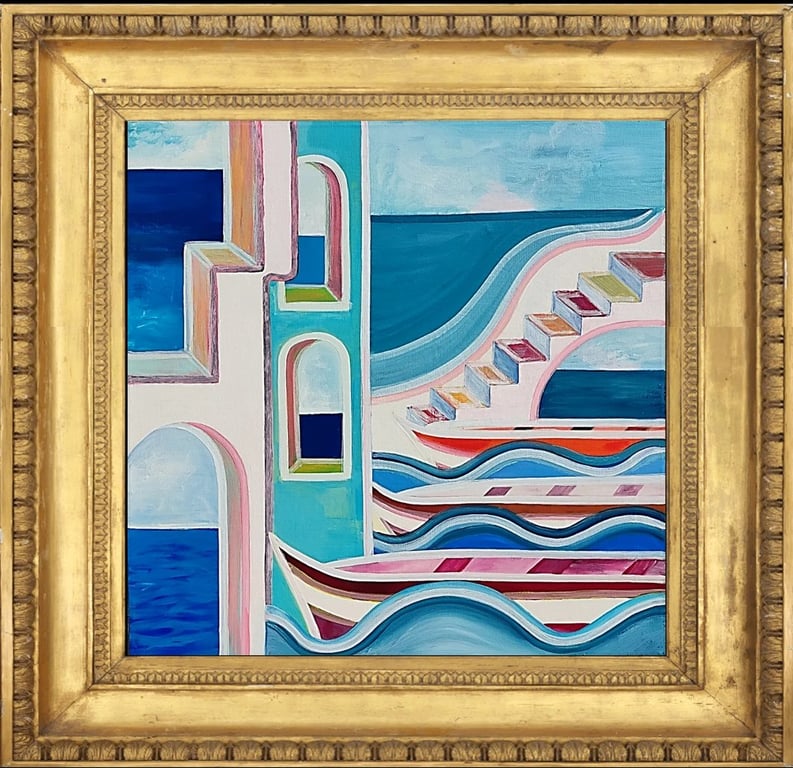
Medium: Acrylic on Canvas
Dimensions: 110 x 110 cm
Year: 2022
Price: $19900.00 USD
Status: available
Title: Seaport Code: AC003B Year: 2001, Switzerland Artist: Alessandro Cardamone Technique: Acrylic on canvas Style: Neo-Cubism / Contemporary Abstract Figuration ________________________________________ Formal Analysis In Porto di Mare, Cardamone constructs a visually complex composition in which the port environment is reinterpreted through a neo-Cubist language. The scene is not descriptive but abstract: maritime elements and boats are broken down into geometric planes, lines, and color blocks that intertwine, generating a continuous internal rhythm. The figurative structures are stylized yet recognizable: hulls, piers, and water elements merge into a compositional mosaic that balances empty and full spaces, diagonals and curves, thin lines and denser color fields. The use of color is particularly calibrated: marine tones of blues, azures, and greens interact with warm ochre accents, creating depth and the impression of light reflecting off the water’s surface. The sense of movement is suggested by the geometry of the planes and the distribution of color, giving the painting vitality despite its abstraction. The space, though abstract, is coherent: the viewpoint is from within the port, with elements guiding the viewer’s gaze along diagonal and oblique paths, generating a simultaneous perception of depth and frontal perspective. ________________________________________ Symbolism and Interpretation Porto di Mare goes beyond mere landscape representation: the port becomes a metaphor for journey, pause, and transformation. Water and boats symbolize the flow of life, its rhythms, and its transitions. The painting captures the tension between movement and stillness, between the dynamism of the water and the solidity of the port structures, reflecting a sense of anticipation and possibility. The Cubist fragmentation suggests multiple simultaneous perspectives: the viewer perceives both the physical structure and the emotional atmosphere of the port. The work can be read as a symbolic space of transition, where natural and human elements merge in a harmonious dialogue between memory, observation, and imagination. ________________________________________ Influences The work engages with the Cubist tradition, particularly Synthetic Cubism, through the decomposition of forms, simultaneity of planes, and geometric construction of space. At the same time, Cardamone introduces a lyrical contemporary sensibility, avoiding the analytical coldness of the historical phase. Echoes of 20th-century European abstract figuration and Mediterranean post-Cubism are perceptible, with particular attention to luminosity and chromatic modulation. The use of acrylic adds freshness and brilliance, making the composition vibrant and immediate while maintaining a rigorous formal architecture. ________________________________________ Critical Evaluation Porto di Mare is a successful example of Cardamone’s ability to transform a traditional subject—the port—into a contemporary aesthetic reflection. The fusion of geometric abstraction and recognizable figurative elements demonstrates technical and poetic mastery: the port is perceptible yet sublimated into an abstract visual language. The strength of the work lies in its capacity to convey movement, light, and atmosphere without resorting to mere naturalistic depiction. The combination of color, form, and compositional rhythm highlights the artist’s maturity and the coherence of his neo-Cubist language updated to contemporary themes. ________________________________________ Conclusion In Porto di Mare (ALECARD 003B), Alessandro Cardamone produces a work that unites tradition and innovation: the port scene is transformed into a visual laboratory where color, form, and composition interact harmoniously. The acrylic on canvas, spatial fragmentation, and chromatic choices contribute to a dynamic and poetic work, capable of conveying both physical perception and emotional reflection. The painting invites the viewer to explore the tension between movement and stillness, nature and structure, reality and artistic interpretation. ________________________________________ Curatorial Note This work belongs to a cycle on the theme of the sea, in which Cardamone explores urban and maritime spaces as places of introspection and memory, transforming them into pictorial experiences of pure perception and symbolism. Porto di Mare is particularly suited for exhibitions focused on contemporary landscape, lyrical abstraction, and the new developments of neo-Cubism in painting. Exhibition Note This work, exhibited in numerous European countries, is part of the collection hosted by the Hong Art Museum in Chongqing, China, from November 2023 to March 2024. Critical text prepared for artistic documentation purposes – Basel 2025
Why collect this work?
Seaport CODE: AC003BE02 offers a focused way to encounter Alessandro Cardamone's practice through a specific work and its recorded materials.
- Alessandro Cardamone's practice: The Artistic Identity and Technique Alessandro Cardamone’s artistic practice is rooted in a rigorous, independent visual philosophy that he defines as Modern Neo-Cubism.
- Title: Seaport Code: AC003B Year: 2001, Switzerland Artist: Alessandro Cardamone Technique: Acrylic on canvas Style: Neo-Cubism / Contemporary Abstract Figuration ________________________________________ Formal Analysis In Porto di Mare, Cardamone constructs a visually complex composition in which the port environment is reinterpreted through a neo-Cubist language.
- The recorded technique or medium is Acrylic on Canvas .
- At 110 x 110 cm, it can be considered for collections that have room for a work of this scale.
About the Artist
Alessandro Cardamone
Alessandro Cardamone is an artist on Mondoir Studio. Artistic discipline: painting. Based in Ottiglio, IT.
Nationality: Italian
The Artistic Identity and Technique Alessandro Cardamone’s artistic practice is rooted in a rigorous, independent visual philosophy that he defines...