Precolombian Art Code .AC0012HDHF02 by Alessandro Cardamone
Explore Mondoir Studio
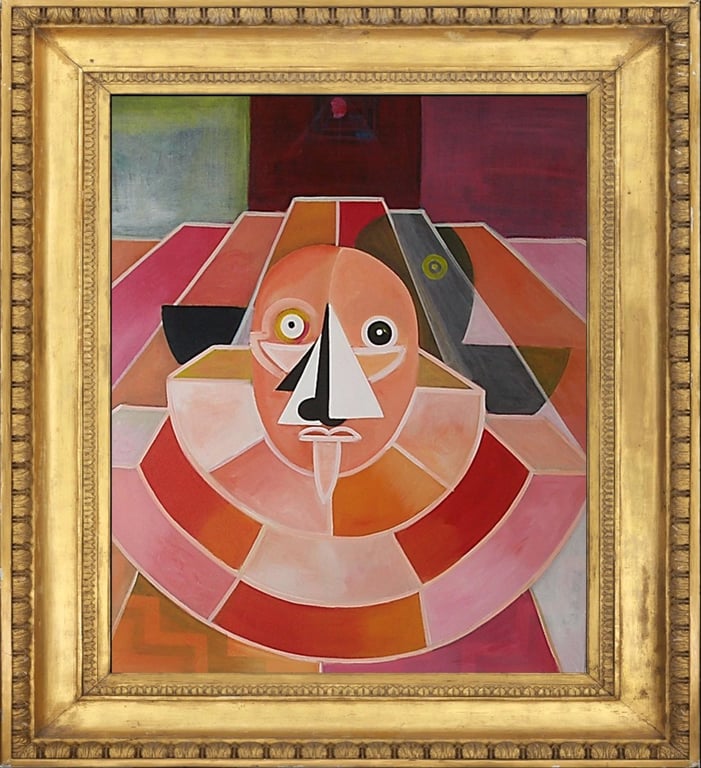
Medium: Stampa su tela
Dimensions: 100 x 120 cm
Edition production year: 2009
Price: $15900.00 USD
Status: available
Hong Art Museum Limited Edition Digital Reproduction on Canvas using the Giggle technique . Signed and numbered by the artist, with a certificate of authenticity Digital print with hand-finished details (design elements or color highlights). Limited edition of 2 out of 10, scale 1:1, using the Gigleec technique on 100% cotton canvas. Work AC0012HD This painting, exhibited in various countries, is part of the collection that will be on display at the Hong Art Museum in Chongqing, China, from October through December 2023 Theme: Pre-Columbian South American cultures. Several works were created on old, unbleached linen over 100 years old, as their texture was deemed suitable for representing this theme. This work was created in Nuglar, Switzerland, in 2009 Title: Arte Precolombiana Code: AC0012H Year: 2009, Switzerland Artist: Alessandro Cardamone Technique: Acrylic on canvas Style: Neo-Cubism / Contemporary Abstract Figuration ________________________________________ Formal Analysis Arte Precolombiana stands out as one of the most layered and dense works in Cardamone’s artistic journey, where sculptural intent merges with an iconographic and symbolic exploration of significant cultural impact. The composition is structured with a frontal, compact layout, populated by totemic, stylized figures that occupy the pictorial space in repeated yet varied modules, suggesting a ritualistic order. Human and animal forms are reduced to essential, geometric volumes almost hieroglyphic interlocked in a visual structure reminiscent of Mayan or Aztec bas-reliefs, translated into a contemporary pictorial language. The chromatic palette is dominated by earthy and mineral tones: ochre, bronze, copper green, and brick red, enriched by accents of turquoise and deep black. The colors do not model but rather mark: each area serves an almost liturgical function, contributing to a sense of ancient sacredness. The line sharp and graphic plays a constructive role: it defines and separates, but at the same time connects symbolic and figurative planes. The work presents itself as a pictorial wall, a modern stele, upon which the artist has inscribed ancestral visions with a synthetic and powerful gesture. ________________________________________ Symbolism and Interpretation The choice of a pre-Columbian theme marks a new register in Cardamone’s production: no longer just feminine introspection or the European urban environment, but a dialogue with archaic civilizations and the languages of origin. The depicted figures resemble masks, idols, ancestors evoking a universe where the human and divine merge. There is no linear narrative here, but an atemporal presence: each figure is an archetype, a visual memory of a culture that spoke through signs and absolute forms. The painting evokes another kind of time: cyclical, mythical when art was not decoration but a vehicle for knowledge and spiritual power. References to the indigenous symbology of the Americas are filtered through a contemporary sensitivity, without mimicking the original aesthetics but instead absorbing and reinterpreting them. The totemic and vertical layout also suggests ideas of "ascent" or "transformation": art as a bridge between earth and sky, matter and spirit. ________________________________________ Influences The work clearly reflects the influence of 20th-century primitivism, but in a less European and more syncretic key. The primary reference is not the African-inspired Picasso, but rather artists like Diego Rivera, Rufino Tamayo, and Wifredo Lam—figures who skillfully fused avant-garde with indigenous mythology. The geometric breakdown recalls synthetic Cubism, but the style is more overtly symbolic than expressive. In this sense, the work also aligns with certain currents in contemporary visionary art, balancing ethnography and abstraction, mysticism and decoration. ________________________________________ Critical Evaluation Strengths: • Mature use of formal synthesis to evoke an archaic world. • Powerful symbolic and spiritual structure. • A strong connection between contemporary art and ancestral languages. • Effective reinvention of the totem as a pictorial image. Compared to other works by Cardamone: • One of his most conceptual and structurally complex canvases. • Shifts away from introspective femininity to explore collectivity, ritual, and universal historical memory. • Marks a moment of cultural and iconographic openness, where the artist engages with the mythical and sacred dimensions of imagery. ________________________________________ Conclusion Arte Precolombiana is a work that serves as a bridge between civilizations between the abstract language of modern art and the deep symbolism of Latin America’s ancestral cultures. Cardamone composes a layered, intense pictorial stele, where every form speaks not only to the eye but to collective memory. His painting becomes both ritual and meditation, and this canvas stands out as one of the most emblematic of his “archetypal” cycle. With Arte Precolombiana, the artist invites us to reinterpret the past not as nostalgia, but as a code to understand the present—offering a form of painting that is simultaneously civilization, spirituality, and contemporary sign. ________________________________________ Exhibition Note This work, exhibited in numerous European countries, is part of the collection hosted by the Hong Art Museum in Chongqing, China, from November 2023 to March 2024. Critical text written for artistic documentation – Basel, 2025
Why collect this work?
A frontal head is held within concentric arcs, while unequal eyes and opposed nose shapes disrupt the image’s strong bilateral order.
- Cardamone calls his practice “Modern Neo-Cubism.” In this case, the term clarifies how facial recognition persists despite the figure’s division into bounded geometric units.
- The photograph shows a small mouth beneath a long black-and-white nose, with sloping bands extending behind the head. These competing frontal and receding structures suspend the figure between portrait, mask and diagram.
- Catalogue metadata describes this object as edition 2 of 10, digitally printed on cotton canvas with hand-finished details, after a 2009 acrylic composition. The available photograph does not identify which marks were added by hand.
- The title invokes pre-Columbian art without documenting a particular culture or source object. The work can therefore support focused discussion about what is preserved, generalized or invented when broad historical categories enter contemporary figuration.
About the Artist
Alessandro Cardamone
Alessandro Cardamone is an artist on Mondoir Studio. Artistic discipline: painting. Based in Ottiglio, IT.
Nationality: Italian
The Artistic Identity and Technique Alessandro Cardamone’s artistic practice is rooted in a rigorous, independent visual philosophy that he defines...