Oceania Code: AC0010 E02 by Alessandro Cardamone
Explore Mondoir Studio
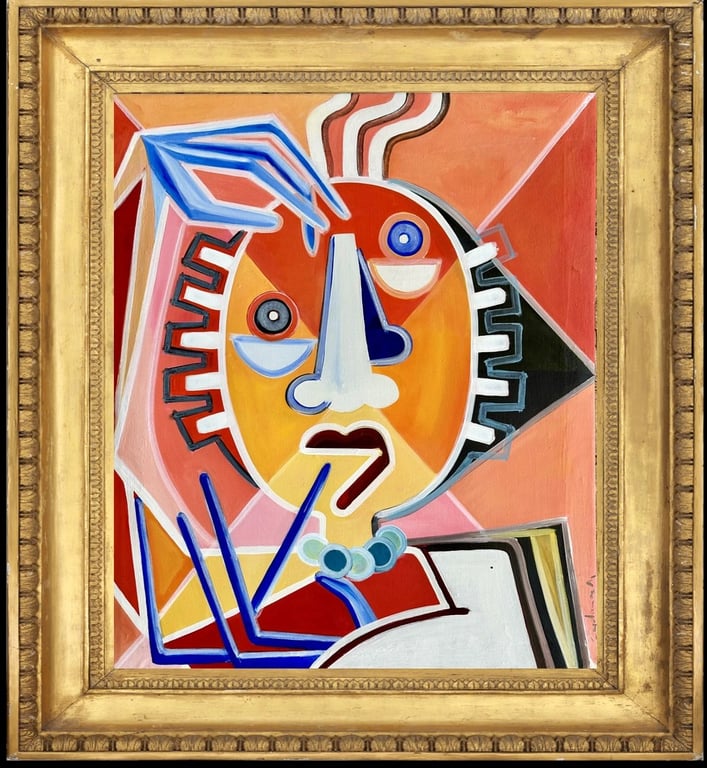
Medium: Acrylic on Canvas
Dimensions: 110 x 130 cm
Year: 1999
Price: $26000.00 USD
Status: available
A limited and unique hand-executed variation by the artist Scale 1:1. Acrylic on stretched canvas. A hand-executed variation of the work AC0020, created in Nuglar Switzerland , in 1999. Limited edition “China 2023” of up to 3 pieces. Each piece will be different and unique, with its own code. The artist will make some modifications to the colors and shapes to ensure the work’s uniqueness. On the back of the work: handwritten signature, description, and fingerprints on all four corners, as shown in the photo. Artist’s work with a certificate of authenticity. Title: Oceanea Tribale Code: AC0020 Year: 1999 Artist: Cardamone Alessandro Technique: Acrylic on canvas Style: Neo-Cubism / Contemporary Figurative Abstraction ________________________________________ Formal Analysis Oceanea Tribale stands as one of Cardamone’s earliest works where his neo-cubist research intersects with archaic and primordial suggestions. The composition is centered on human and totemic figures, fragmented and recomposed through broken yet rhythmic geometric planes, evoking the incisiveness of pre-Columbian bas-reliefs and Oceanic tribal masks. The lines, though sharp, soften into curves that mitigate the geometric rigidity, while the palette unfolds in earthy reds, golden ochres, deep blues, and jade greenscolors that recall sacred rituality and the raw force of untouched nature. The result is a vibrant composition, intertwining historical memory and modern pictorial language, fusing archaic monumentality with chromatic lyricism. ________________________________________ Symbolism and Interpretation The painting emerges as a meditation on origins, on humankind’s ancestral relationship with the sacred and with nature. The figures, reminiscent of idols or masks, seem to guard ancient secrets: their fixed and magnified gaze becomes a bridge between the earthly and the spiritual realms. The hands, likewise emphasized and stylized, suggest ritual gesture, tribal dance, and connection with cosmic energy. Decorative elements in the backgroundgraphic signs, suspended geometric motifs—take on the value of totemic symbols or lost codes, an allusion to a universal language that transcends epochs and cultures. In this sense, Oceanea Tribale is not merely an homage to tribal art, but also a reflection on the universality of human expression and its spiritual power. ________________________________________ Influences The cubist matrix, traceable to Picasso and Braque, is evident in the fragmentation of volumes and the simultaneity of perspectives. Yet Cardamone enriches this structure with references to primitive and tribal art, particularly: • Oceanic and tribal masks and totems; • Chromatic rituality reminiscent of Fauvism and certain expressionist experiments; • A graphic sensitivity anticipating elements of global contemporary art, capable of dialoguing with extra-European cultures without lapsing into mere citation. ________________________________________ Critical Evaluation Oceanea Tribale stands out for its archaic force and its ability to merge languages separated by centuries into a personal and contemporary synthesis. Color use is not merely aesthetic, but carries ritual and symbolic weight, evoking a primordial world of myths and legends. Cardamone succeeds in transforming cubist rigor into a poetic and accessible language, where the pre-Columbian past becomes a key for reflecting on the present. ________________________________________ Conclusion This work marks an important moment in the artist’s research, where Cubism opens itself to intercultural and spiritual contaminations. Oceanea Tribale is a dialogue between eras and civilizations, an ideal bridge between modern European art and pre-Columbian and Oceanic roots. Alessandro Cardamone thus reaffirms his ability to reinterpret past forms with contemporary sensitivity, creating a painting that is at once memory and vision, ritual and poetry. Critical text written for artistic documentation purposes – Basel, 2025
Why collect this work?
A face is built from mismatched eyes, displaced contours, and hovering hands, making recognition depend less on likeness than on the temporary alignment of signs.
- Cardamone describes his practice as “Modern Neo-Cubism.” Here, that framework helps explain the face’s division into outlined components, although the playful asymmetry matters more than the label.
- In the photograph, an oval head anchors intersecting wedges and curves. The unequal eyes, long projecting nose, and bent mouth remain readable as features while resisting a single viewpoint; hands above and below compress figure and gesture into one crowded field.
- The catalogue identifies acrylic on canvas. Acrylic can support the opaque blocks and sharply bounded lines documented here, allowing orange, blue, red, black, and white areas to function as distinct structural units rather than atmospheric modelling.
- This painting provides a focused case for considering how portraiture survives fragmentation: identity is not erased, but reconstructed through repeated acts of visual recognition.
About the Artist
Alessandro Cardamone
Alessandro Cardamone is an artist on Mondoir Studio. Artistic discipline: painting. Based in Ottiglio, IT.
Nationality: Italian
The Artistic Identity and Technique Alessandro Cardamone’s artistic practice is rooted in a rigorous, independent visual philosophy that he defines...