Femme au Cafe du Louvre Code AC008BD05 by Alessandro Cardamone
Explore Mondoir Studio
Medium: Stampa su tela
Dimensions: 100 x 130 cm
Edition production year: 2001
Price: $4500.00 USD
Status: available
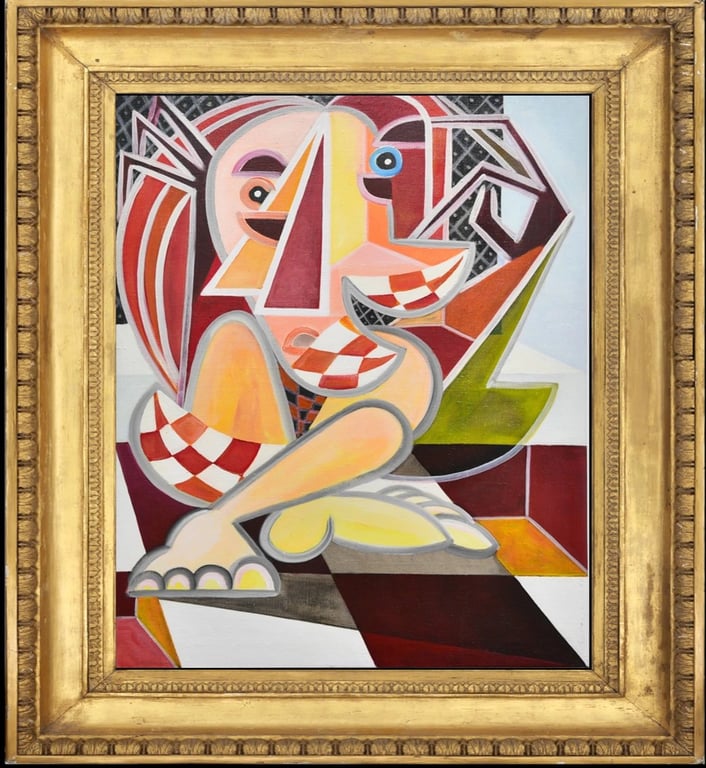
Limited edition, digital reproduction by the Hong Art Museum on Giggle Canvas Signed and numbered by the artist. Comes with a certificate of authenticity. Dell’s 2001 work AC008B, created in Nuglar, Switzerland, in 2001, was exhibited in various European countries and at the Hong Art Museum in Chongqing, China, in 2023–2024. It was stolen in Italy on April 8, 2026. Limited edition of 1/20, Gigleec technique, on 100% cotton, 380 g, matte cotton canvas, with description, signed and numbered by the artist on the back as shown in the photo. Comes with a certificate of authenticity for the work AC008B Switzerland 2001 Catalogue Sheet Title: Femme au Café du Louvre Code: AC008B Year: 2001, Switzerland Artist: Alessandro Cardamone Technique: Acrylic on canvas Style: Neo-Cubism / Contemporary Abstract Figuration ________________________________________ . Formal Analysis This work by Cardamone, one of the most important and representative pieces of the Femme au Café du Louvre series, presents a composition centered on the female figure, emerging as the protagonist within an abstract urban space interpreted through a neo-Cubist language. The woman is stylized and structured in overlapping geometric planes, while warm and cool color surfaces interact to create a harmonious and vibrant visual rhythm. The body, rendered through soft lines and volumetric segments, suggests inner tension and a balance between dynamism and apparent stillness. The hands and limbs, often emphasized in Cardamone’s works, guide the viewer’s gaze across the composition. The surrounding space, though abstract, is suggested through diagonals and overlapping planes that introduce depth and movement, while the ochre, turquoise, sand, and blue palette conveys the suspended and luminous atmosphere typical of a European café set within an urban context. ________________________________________ Symbolism and Interpretation The Café du Louvre scene becomes a space of observation and introspection: the woman is not only the subject of the composition but also a symbol of presence, reflection, and dialogue between the everyday and the aesthetic. The Cubist fragmentation suggests multiple simultaneous perspectives, conveying the complexity of modern perception and the relationship between the individual and urban space. The work explores the threshold between the visible and the invisible: stylized objects, architectural elements, and abstract planes serve as metaphors for memory, identity, and interiority. The female figure functions as both observer and observed, embodying the fusion between everyday time and the artistic dimension. ________________________________________ Influences The visual language clearly draws on Synthetic Cubism, with the decomposition of planes and the simultaneity of viewpoints. Cardamone reinterprets these historical roots in a lyrical and contemporary key, avoiding analytical coldness in favor of light, color, and emotional rhythm. Influences of Picasso and Braque are evident in the geometric structure and figure construction, while the chromatic choices evoke Mediterranean sensibilities and 20th-century European abstract figuration. Acrylic paint, with its brilliance and transparency, allows the combination of formal rigor and poetic immediacy. The style is personal and recognizable, achieving a successful synthesis of historical tradition and psychological narrative. ________________________________________ Critical Evaluation Femme au Café du Louvre (ALECARD 008B) represents a significant moment in Cardamone’s research: the artist reconciles abstraction and figuration, formalism and emotional sensitivity. The female figure remains recognizable yet transformed, and the composition communicates balance, movement, and chromatic harmony. The work demonstrates technical mastery and expressive maturity, successfully renewing the historical Cubist language and situating it within a contemporary context without losing narrative and poetic potential. ________________________________________ Conclusion Femme au Café du Louvre (ALECARD 008B) is an extraordinary work for both visual and interpretative depth. Alessandro Cardamone consolidates his path through an intimate and emotional Cubism, presenting a complex contemporary female figure suspended between identity, solitude, and introspection. The painting speaks with a rich, personal, and meaning-laden pictorial language. Cardamone blends tradition and contemporaneity: the female figure, interpreted through a neo-Cubist language, engages in dialogue with the urban space and the viewer’s visual memory. Acrylic on canvas, the compositional structure, and the chromatic choices provide a vision that is both recognizable and renewed, inviting reflection on the relationship between subject, space, and emotional perception. ________________________________________ Curatorial Note This work is part of a thematic cycle in which Cardamone explores the relationship between the female figure and the urban environment as symbols of introspection, memory, and contemporary identity. Femme au Café du Louvre is ideal for exhibitions dedicated to contemporary abstract figuration, the reinterpretation of Cubism, and reflections on the role of space and figure in modern painting. Exhibition Note This work, exhibited in several European countries, is part of the collection at the Hong Art Museum in Chongqing, China, from November 2023 to March 2024.
Why collect this work?
A frontal figure is assembled from interlocking profiles, limbs and patterned planes, making recognition depend on continual shifts between body and surrounding geometry.
- Cardamone describes his practice as “Modern Neo-Cubism.” Here, that framework clarifies how the female figure remains legible despite being split into competing viewpoints and emphatic contours.
- The photograph shows repeated red-and-white checks crossing face, arm and lower body. These echoes bind separated forms together, while the enlarged hand and foot give the compressed composition an assertive physical weight.
- Catalogue metadata identifies this object as a numbered digital reproduction on cotton canvas after a 2001 acrylic painting. Reproduction can preserve the design’s sharp divisions and repeated motifs, but the photograph cannot establish the original painting’s surface or exact colour.
- Encountering this edition alongside its source painting would sharpen questions about what survives translation: not the original acrylic surface, but a carefully structured contest between figure, pattern and shallow space.
About the Artist
Alessandro Cardamone
Alessandro Cardamone is an artist on Mondoir Studio. Artistic discipline: painting. Based in Ottiglio, IT.
Nationality: Italian
The Artistic Identity and Technique Alessandro Cardamone’s artistic practice is rooted in a rigorous, independent visual philosophy that he defines...