Femme au Cafe du Louvre Code AC0022GE02 by Alessandro Cardamone
Explore Mondoir Studio
Medium: Acrylic on Canvas
Dimensions: 100 x 130 cm
Year: 2026
Price: $26500.00 USD
Status: available
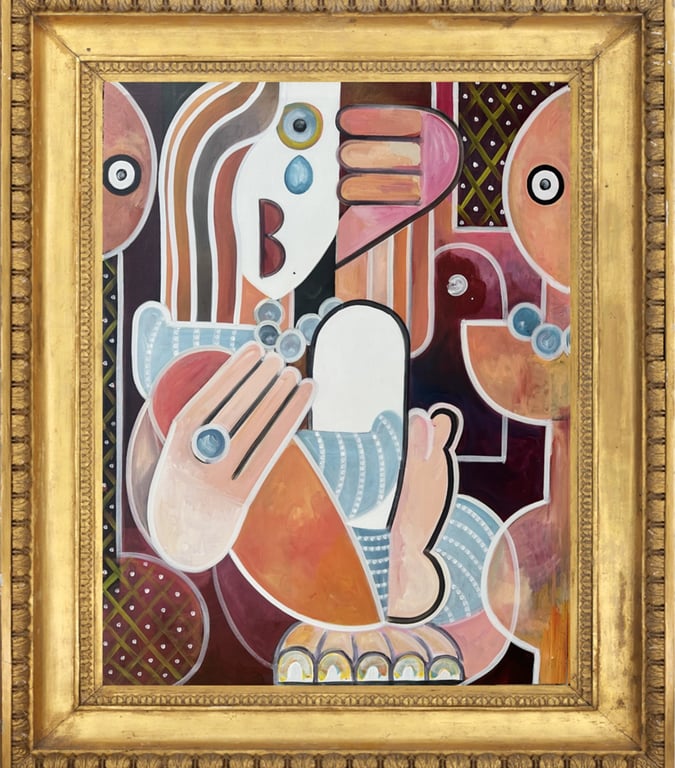
A limited and unique hand-executed variation by the artist Scale 1:1. Acrylic on stretched canvas. A hand-executed variation of the work AC0022G, created in Italy , in 2026. Limited edition “China 2023” of up to 3 pieces. Each piece will be different and unique, with its own code. The artist will make some modifications to the colors and shapes to ensure the work’s uniqueness. On the back of the work: handwritten signature, description, and fingerprints on all four corners, as shown in the photo. Artist’s work with a certificate of authenticity. Title: Femme au Café du Louvre Code: AC0022G Theme: Femme au Café du Louvre Preparatory Sketch: El Quseir, Egypt, November 2025 Execution of the Work: Italy, February 2026 Artist: Alessandro Cardamone Technique: Acrylic on canvas Dimensions: 130 × 100 cm Style: Neo-Cubism / Contemporary Abstract Figuration The work forms part of Cardamone’s long-standing artistic exploration devoted to Femme au Café du Louvre, a cycle which, according to the artist’s documentation, originated from his Parisian experience in the spring of 1999 and which, over the years, has generated numerous variations on the relationship between the female figure, space, and memory. Formal Analysis In AC0022G, Alessandro Cardamone brings the visual language of Femme au Café du Louvre into a phase of remarkable synthesis and monumentality. The female figure is no longer simply placed within the pictorial space: her own body becomes the structure through which that space is constructed. The composition is dominated by a system of large anatomical masses transformed into geometric elements. The elongated white face forms the upper axis of the work; the monumental hand crossing the forehead both interrupts and completes the physiognomy. Below, the hands, legs and, above all, the large foot assume deliberately monumental proportions. It is precisely through this disproportion that the work achieves one of its greatest strengths. Anatomy progressively relinquishes its naturalistic function and acquires an architectural role: the foot becomes a foundation, the leg a column, the arm a structural diagonal, and the hand a rhythmic surface. Particularly successful is the relationship between the large central orange mass and the pale blue areas of the costume. Orange generates warmth and a sense of spatial advancement, while blue visually recedes and introduces a luminous pause. Around them, burgundy, brown, antique pink and almost black areas create a deeper chromatic structure. The white outlines act as a genuine framework: they separate the fields of colour while simultaneously recomposing their fragmentation. The construction is therefore Neo-Cubist, yet the result does not appear analytical. Geometry is employed to concentrate the emotional presence of the figure. The Face and the Gaze One of the most compelling elements of the work is the face. The broad off-white surface creates an almost metaphysical suspension. Upon it remain only a few essential signs: the circular eye, the blue tear, the geometrically constructed mouth and the small black dot. The eye makes no attempt at anatomical representation. It is a concentric sign, almost a visual target, immediately establishing the psychological centre of the upper section of the composition. The blue tear introduces an entirely different note. Within a strongly geometric composition, it appears as an extremely simple emotional presence. Precisely because of this simplicity, it acquires considerable expressive power: it does not necessarily describe pain, but may allude to memory, sensitivity, distance or introspection. Hands and Feet: The Body Becomes Architecture This can be considered one of the most powerful aspects of AC0022G. The left hand is enormous in relation to the face and torso. Its parallel fingers create an almost musical rhythm, while the circular element embedded in the hand interrupts the linear sequence. Even more significant is the foot. Positioned frontally in the lower section of the composition, it functions almost as the base of a sculpture. The five rhythmically articulated toes create a sequence of arches that simultaneously evokes anatomy and architecture. This transformation of hands and feet into structural elements has become one of the most recognisable features of Cardamone’s visual vocabulary. The public presentation of the major 2026 exhibition in Casale Monferrato—featuring 75 works distributed across eleven rooms—also emphasised the artist’s investigation into the construction of the figure and the relationship between mark and pictorial space. Symbolism and Interpretation The woman in AC0022G should not be interpreted as an individual portrait. She is, rather, a mental figure. Her posture appears introspective, yet not fragile. The monumentality of the limbs contradicts any purely melancholic interpretation: we are confronted with a figure who simultaneously protects herself, observes herself and physically occupies the surrounding space. The large hand near the face may be interpreted as a gesture of protection, meditation or the shielding of the gaze. This ambiguity is important because it prevents the work from becoming a straightforward narrative illustration. Two large anthropomorphic presences appear at the sides. Rather than actual characters, they can be understood as totemic presences, silent witnesses to the scene. The female figure is therefore positioned between two forms of otherness: her own inner world and the gazes of the external world. This creates an intriguing psychological condition: the woman looks and, at the same time, is being looked at. The Café as a Mental Space In this work, an important transition can be observed in relation to the earlier formulations of the series. The documentation surrounding the cycle traces the origin of Femme au Café du Louvre to the visual encounter with a woman seated in a Parisian café and describes the numerous works that subsequently developed from that initial experience. Yet in AC0022G, the café has almost completely disappeared as a recognisable physical setting. This does not weaken the theme. On the contrary, it demonstrates its evolution. The Café du Louvre has become a mental category: a place of waiting, observation, memory and the encounter between the individual and the world. The fragmented architecture of the background no longer describes Paris. It could belong to Paris, to Egypt where the sketch originated, to Italy where the canvas was executed, or to none of these places. It is a space of memory. The Relationship Between Egypt and Italy The genesis of the work—the preparatory sketch created in El Quseir in November 2025 and the canvas executed in Italy in February 2026—adds another dimension to its interpretation. It would not necessarily be appropriate to speak of direct Egyptian influences, since such a conclusion would require a statement from the artist or further documentary evidence. Nevertheless, when observing the work, the presence of strongly frontal and almost totemic lateral figures, together with the monumentality of the protagonist, does indeed generate a sense of the archaic. It is particularly interesting that a theme originating from the Parisian experience should be reinterpreted through a sketch conceived many years later in Egypt and subsequently transformed into a painting in Italy. Paris → Egypt → Italy thus becomes, at least within the biographical history of the work’s creation, a geographical stratification of memory. Pictorial Language AC0022G clearly demonstrates why simply defining Cardamone as a “Cubist” would be reductive. The historical reference remains evident: fragmentation of space, simultaneity of planes, anatomical distortion and the independence of colour from naturalistic representation. The objective, however, is different. Cardamone does not appear primarily interested in fragmenting perception. Rather, he employs fragmentation to construct an emotional condition. Geometry therefore becomes a psychological grammar. Within the artist’s public body of work, this continuity is clearly visible: numerous versions of Femme au Café du Louvre, produced from the 2000s onwards, document an evolution towards increasingly personal, softer and more lyrical forms in relation to the original Cubist matrix. Artistic Influences The reference to historical Cubism, and particularly to Picasso, remains perceptible, although in AC0022G it appears less dominant than in earlier works. The constructive monumentality associated with Fernand Léger, certain developments within European figuration of the second half of the twentieth century, and a sensitivity towards archetypal and primitive forms can also be perceived. Yet these references now function primarily as genealogy. The vocabulary of the work—the circular eye, the tear, the monumental hand, the architectural foot, totemic figures, environmental geometries, the fragmented body and Mediterranean chromaticism—belongs to a system that Cardamone has progressively made his own. The artist’s own public documentation similarly describes his visual language as a personal reworking of Picassian influence through more playful colours and softer forms. Critical Assessment AC0022G can be regarded as an important work within the recent phase of the series, above all for one fundamental reason: it does not merely attempt to reproduce the formula established by the historical Femme au Café du Louvre works. It develops it further. In earlier versions, the relationship between woman–café–environment was often more explicitly narrative. Here, instead, we witness the transition: figure → monumental body → body-as-architecture → psychological space. This is arguably the work’s most significant contribution. The pictorial surface also retains an important handmade quality. Its subtle variations of brushwork prevent the geometry from becoming excessively graphic or digital and preserve its connection with the material nature of painting. Another strength is the absence of a single perspective. The eye moves continuously from the face to the upper hand, the spheres, the monumental lower hand, the leg, the foot and the lateral presences. The painting must be travelled through visually, rather than merely observed frontally. Position Within the Femme au Café du Louvre Cycle If one were to construct a future retrospective of the cycle, AC0022G should not simply be placed among the works produced in 2026. It could instead represent a specific evolutionary phase that might be defined as: The Monumentalisation of the Femme This is a phase in which the figure no longer requires the traditional elements of the café in order to be identified with the cycle. The original subject has been internalised. The major solo exhibition held in 2026 at the Castello del Monferrato brought together 75 works and presented precisely this stylistic evolution and the relationship between the construction of the figure and pictorial spatiality. AC0022G, through both its characteristics and its date, can therefore be understood within the context of this recent phase of maturation. Conclusion Femme au Café du Louvre – AC0022G represents a mature synthesis of Alessandro Cardamone’s exploration of the female figure. Originating from a sketch created in El Quseir in November 2025 and translated into painting in Italy in February 2026, the work definitively transforms the protagonist from a figure situated within an environment into the generative structure of the environment itself. Monumental hands and feet acquire architectural significance; the eye becomes a symbol of perception; the tear introduces the dimension of memory; and the lateral presences transform the scene into a psychological theatre. Cubism remains a recognisable root, but it is no longer the final destination. Geometric fragmentation is employed as a means of constructing an emotional, symbolic and personal form of figuration. AC0022G can therefore be understood simultaneously as a work of continuity and evolution: it preserves the identifying elements developed throughout the long Femme au Café du Louvre cycle, while leading them towards greater monumentality, a reduction of literal narrative and a conception of the body as a true architecture of memory.
Why collect this work?
A stretched face, enlarged hands, and a broad foot interlock so tightly that the seated figure functions as the picture’s structure, compressing portrait and setting into one dense arrangement.
- Cardamone calls his practice “Modern Neo-Cubism.” That artist-reported term is useful here because the body remains recognizable even as its proportions and spatial relationships are reorganized.
- In the supplied photograph, dark contours divide pale limbs from terracotta, burgundy, blue, and patterned passages. Repeated circles can read as eyes, joints, or ornaments, weakening any firm boundary between figure and surroundings.
- Catalogued as acrylic on stretched canvas, the painting uses broad, opaque-looking areas alongside narrow outlines and small repeated marks. These contrasts hold together a composition crowded with overlapping anatomical fragments.
- Dated 2026 and catalogued at 130 × 100 cm, this work gives figurative painting an architectural role: bodily scale and placement, rather than conventional likeness, become its principal means of describing a person.
About the Artist
Alessandro Cardamone
Alessandro Cardamone is an artist on Mondoir Studio. Artistic discipline: painting. Based in Ottiglio, IT.
Nationality: Italian
The Artistic Identity and Technique Alessandro Cardamone’s artistic practice is rooted in a rigorous, independent visual philosophy that he defines...