Femme au Cafe du Louvre AC0040GDHF03 by Alessandro Cardamone
Explore Mondoir Studio
Medium: Stampa su tela
Dimensions: 93 x 120 cm
Edition production year: 2012
Price: $13900.00 USD
Status: available
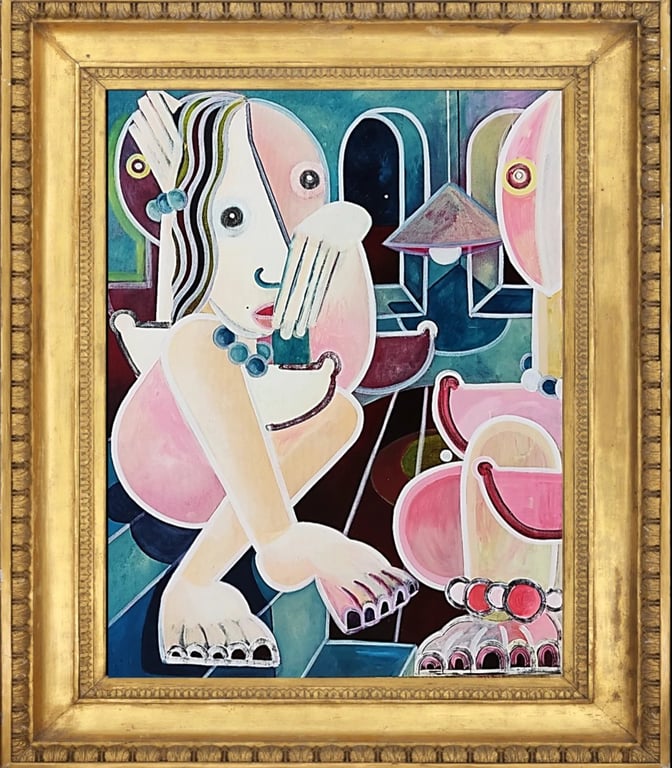
Digital print with hand-finished details (design elements or color highlights). Limited edition, digital reproduction by the Hong Art Museum on Giggle Canvas Signed and numbered by the artist. Comes with a certificate of authenticity. Limited edition reproduction (3 out of 10) on a 1:1 scale using Giggle technology on matte cotton canvas (100% cotton, 380 g), with the artist’s numbered signature on the back as shown in the photo. Comes with a certificate of authenticity. of the work AC0040G, created in 2012 in Nuglar, Switzerland, and exhibited at the Hong Art Museum in Chongqing, China It is possible to adjust the dimensions according to the customer’s requirements Translated with DeepL.com (free version) Catalogue Sheet Title: Femme au Café du Louvre Code: AC0040G Year: 2012, Switzerland Artist: Alessandro Cardamone Technique: Acrylic on canvas Style: Neo-Cubism / Contemporary Expressionism ________________________________________ Formal Analysis Femme au Café du Louvre (ALECARD0040G) represents one of the most refined and lyrical interpretations of the renowned series of the same name, initiated by Cardamone in 1999. In this 2012 version, the artist achieves a more harmonious synthesis between geometric construction and chromatic vibration, merging the formal rigor of neo-cubism with a controlled yet intense painterly sensuality. The female figure, seated in a composed pose, is built through an interplay of planes and diagonals that define a dynamic balance between stability and movement. The lines, precise yet fluid, give the body a sense of living presence, while the volumes—broken down into soft and luminous segments—suggest a visual rhythm akin to an inner music. The palette unfolds in warm, refined tones — ochre, Venetian red, ivory, and Prussian blue — alternating with light transparencies and delicate color fields. The light is not descriptive but dramatic: it traverses the composition as an emotional current, uniting figure and space into a vibrant continuum. The table, cup, and elements of the Parisian setting are reduced to symbolic fragments, dissolved into an abstract language that allows the figure to emerge as the poetic and psychological core of the work. ________________________________________ Symbolism and Interpretation The subject of Femme au Café du Louvre stems from a real-life episode experienced by the artist in 1999 in Paris — the vision of a solitary woman sipping tea in a café near the Louvre. From that image of quiet contemplation, Cardamone developed an extensive exploration of the feminine presence as a symbol of interiority and reflection. In this 2012 version, the figure is no longer merely observed but interiorized: she becomes an emblem of thought, memory, and waiting. Her introspective posture and suspended gaze evoke a moment of reflection balanced between reality and dream. The café, traditionally a public place, is transformed into a mental and spiritual space — an “inner tower” where the woman withdraws to rediscover herself. The cup, her hands, and the surrounding light become symbols of silent communication and creative contemplation. ________________________________________ Influences The work openly dialogues with Synthetic Cubism and the broader tradition of European modern painting. The influences of Picasso and Juan Gris are visible in the geometric construction and the equilibrium between line and color, yet Cardamone reinterprets these elements through a personal, lyrical sensibility. Echoes of Matisse can be felt in the chromatic lightness and the pursuit of pure visual emotion, while the figure’s monumentality recalls Léger and the French post-cubist school. However, Cardamone’s vision is more intimate and psychological: his neo-cubism does not depict reality but transfigures it into an inner language. ________________________________________ Critical Evaluation Femme au Café du Louvre (ALECARD0040G) stands as a mature point of equilibrium between abstraction and figuration in Cardamone’s oeuvre. The work demonstrates the artist’s ability to merge the formal discipline of design with a deeply controlled emotional intensity. Strengths: • Balanced synthesis between geometric construction and chromatic lyricism. • Strong symbolic presence without reliance on direct narration. • Use of color as an emotional and psychological language. • Poetic vision of the feminine figure as a universal emblem of introspection. Distinctive features compared to other works in the series: • Greater abstraction and formal clarity. • Brighter, more harmonious colors that create a meditative tone. • The figure becomes more spiritual and less earthly, embodying the ideas of memory and suspended time. Through this, Cardamone transforms an everyday scene into an icon of contemplation, where the neo-cubist language becomes a tool for reflecting on the very essence of perception. ________________________________________ Conclusion With Femme au Café du Louvre (ALECARD0040G), Alessandro Cardamone offers one of his most poetic and refined works — a piece that fuses memory, introspection, and form. The female figure becomes a universal symbol of creative silence, suspended between presence and thought. The work stands out for its ability to evoke emotion through a rigorous plastic language and color that becomes a vehicle of spirituality. Here, painting becomes meditation, and the everyday transforms into myth. ________________________________________ Curatorial Note This work belongs to the Femme au Café du Louvre cycle, initiated in 1999 and developed across more than seventy compositions. It represents one of the most balanced and mature versions of the theme, in which Cardamone merges the neo-cubist language with a poetic and contemplative dimension. Ideal for exhibitions dedicated to contemporary female figuration, modern symbolism, and the spiritual reinterpretation of Cubism, the work has been exhibited in several European countries and is part of the international collection of the Hong Art Museum in Chongqing, China, displayed from November 2023 to March 2024. Exhibition Note This painting, exhibited in numerous European countries, is part of the collection hosted by the Hong Art Museum in Chongqing, China, from November 2023 to March 2024. Critical text written for artistic documentation purposes – Basel, 2025
Why collect this work?
A raised hand blocks the central face while a second, cropped visage looks inward, turning a café scene into a study of obstructed and displaced attention.
- Cardamone calls his practice “Modern Neo-Cubism.” In this work, that description helps account for anatomy treated as rearrangeable shape rather than continuous bodily form.
- In the photograph, the main figure’s eye, hand and foot compete as focal points. Circular accents recur across pupils, beads and upholstery, binding otherwise disjointed parts into a controlled pattern.
- Catalogue metadata identifies a digital print on cotton canvas with hand-finished details, derived from a 2012 acrylic painting. That combination permits local variation within an edition, though the photograph cannot establish its surface texture.
- The work is useful for examining how portraiture can distribute identity across glances, ornaments and bodily fragments, withholding the direct access to a face that portrait conventions often promise.
About the Artist
Alessandro Cardamone
Alessandro Cardamone is an artist on Mondoir Studio. Artistic discipline: painting. Based in Ottiglio, IT.
Nationality: Italian
The Artistic Identity and Technique Alessandro Cardamone’s artistic practice is rooted in a rigorous, independent visual philosophy that he defines...