Femme au Cafe du Louvre- Code :AC0057DHF04 by Alessandro Cardamone
Explore Mondoir Studio
Medium: Acrylic on Canvas
Dimensions: 100 x 130 cm
Edition production year: 2026
Price: $14900.00 USD
Status: available
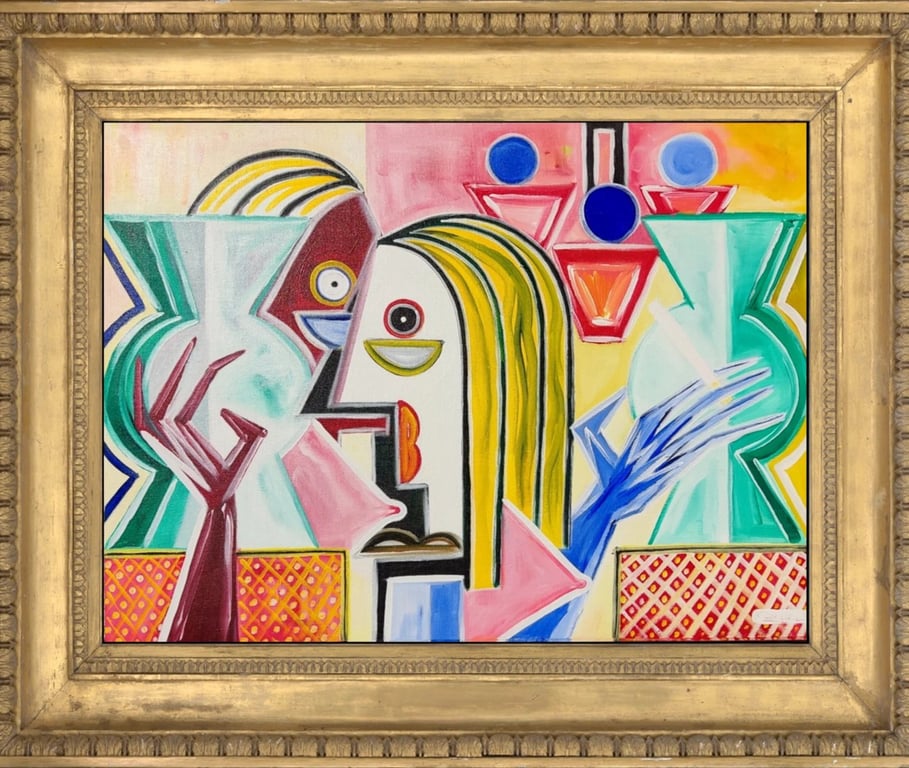
Digital print with hand-finished details (design elements or color highlights). Limited digital reproduction (3/30) on 100% cotton canvas, a 1:1 scale reproduction of the artwork AC0057 *Femme Au Café Du Louvre*, created in Nuglar, Switzerland, in 2000 and exhibited in various European countries and at the Hong Art Museum in Chongqing, China, in 2023/2024 Dimensions can be adjusted to suit the client’s requirements Paris, spring 2000: one rainy morning, I entered the Café du Louvre, which was rather deserted at that hour, and found a very distinctive atmosphere. At the far end of the room, an elegant lady was sipping her tea, framed by a large fireplace flanked by two large vases. Whilst waiting for my coffee, I made a sketch of the scene before me, and from that sketch emerged around 60 paintings. I never met this lady… Title: Femme au Café du Louvre Code: AC0057 Year: 2000, Switzerland Artist: Alessandro Cardamone Technique: Acrylic on canvas Style: Neo-Cubism / Contemporary Abstract Figuration ________________________________________ Formal Analysis Femme au Café du Louvre (ALECARD0057) represents one of the most emblematic and foundational works of the eponymous cycle, inaugurating in 2000 a pictorial research that would accompany Alessandro Cardamone for over two decades. In this version—still highly experimental yet already fully recognizable within the artist’s language—the female figure emerges as the absolute center of the composition, inscribed within a complex and vibrant geometric structure. The composition is built on a dynamic pyramidal framework, where oblique lines and fragmented color fields generate continuous visual tension. The woman’s body—deconstructed and recomposed into angular planes—retains a coherent plasticity and a strong emotional presence. Light, filtered through shades of ochre, carmine red, blue, and pearl gray, does not describe but constructs: the figure seems to glow from within, as though animated by an inner energy. The face, synthesized in a few essential strokes, conveys both introspection and distance, while the café elements—vases, table, and lamp—dissolve into geometric symbols. The setting is not realistic but mental: a suspended space where matter, color, and thought converge. ________________________________________ Symbolism and Interpretation This work, inspired by a real episode experienced by the artist in 1999 at the Café du Louvre in Paris, transforms an everyday moment into an archetypal image of contemplation. The portrayed woman is not a subject but a symbol—she represents the quiet of thought, the strength of creative solitude, the threshold between the visible and the inner world. The act of sipping tea becomes a meditative ritual; the cup, a simple domestic object, acquires a sacred meaning, symbolizing focus and introspection. The café—an inherently public space—is transfigured into a spiritual one, a “room of the soul” where the woman, as a universal figure, embodies the very idea of contemplation. The cubist language, with its analytical fragmentation, becomes here a means to express the complexity of being: fragmentation as a metaphor for the mind, light as the energy of thought. The figure, though seemingly motionless, vibrates with inner tension—expectation, memory, and presence. ________________________________________ Influences In Femme au Café du Louvre (ALECARD0057), the roots in the Cubism of Picasso and Gris are clearly perceptible, as are echoes of Léger’s synthetic expressionism and Matisse’s chromatic sensitivity. Yet from this early stage, Cardamone introduces a personal and poetic dimension that transcends stylistic citation. The geometric construction recalls the cubist lesson but is enriched with a lyrical and spiritual quality that foreshadows the artist’s mature poetics. The use of acrylic—with its transparency and layering—creates a luminous vibration that lends the work an almost musical character. One can also detect resonances of postwar Italian painting, in its synthesis of figuration and abstraction, though filtered through a cosmopolitan, European language in which Paris represents not only a real place but also a cultural and spiritual myth. ________________________________________ Critical Evaluation This 2000 version constitutes a foundational stage in Alessandro Cardamone’s artistic poetics. It is here that the theme of the “contemplative woman” finds its first iconic and symbolic definition, destined to evolve over the following years. Strengths: • Compositional power and structural clarity combined with palpable emotional intensity. • Masterful use of color as a constructive and psychological element. • Ability to transform an ordinary scene into a universal and metaphysical image. • Balance between formal analysis and inner lyricism. Distinctive Features: • The work defines Cardamone’s visual “vocabulary”: geometric planes, synthesized volumes, inner light. • The tension between real and mental space is particularly evident. • The female figure becomes an archetype rather than a portrait—a symbol of waiting and awareness. In this version—one of the earliest and most significant in the series—the poetic intent is clear: to narrate silence, waiting, and fragmented identity through compositional rigor and emotional
Why collect this work?
A face assembled from opposing profiles and frontal eyes turns a café interior into a contest between recognition and fragmentation.
- Cardamone reports that a 2000 café sketch prompted about sixty paintings. That serial approach helps explain why the woman functions less as an individual portrait than as a motif repeatedly reorganized.
- In the photograph, heavy dark contours lock the pale central head between a second face and two large turquoise vessels. Repeated circles suggest eyes, ornaments and cups, making looking itself the scene’s organizing action.
- The catalogue variously records acrylic on canvas and edition 3/30, described as a digital print on cotton canvas with hand-finished details. Digital transfer could retain the crisp divisions and saturated contrasts, but the photograph cannot establish surface handling or hand finishing.
- Encountered as a numbered reproduction of an earlier composition, this object raises a specific question: which parts of a painting’s identity reside in its image, and which depend upon its material execution? That tension is its clearest curatorial significance.
About the Artist
Alessandro Cardamone
Alessandro Cardamone is an artist on Mondoir Studio. Artistic discipline: painting. Based in Ottiglio, IT.
Nationality: Italian
The Artistic Identity and Technique Alessandro Cardamone’s artistic practice is rooted in a rigorous, independent visual philosophy that he defines...