Coastal Countries -Code: AC003LDHF02 by Alessandro Cardamone
Explore Mondoir Studio
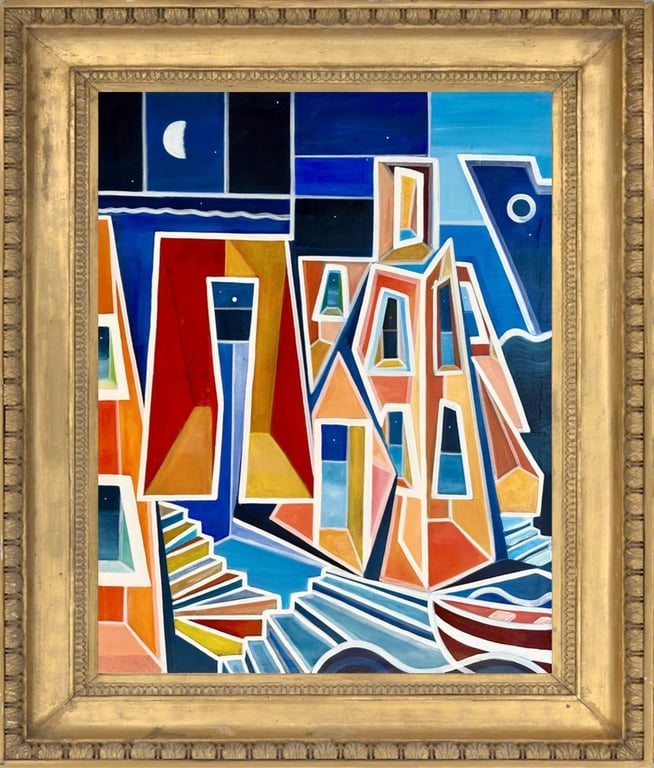
Medium: Stampa su tela
Dimensions: 100 x 130 cm
Edition production year: 2003
Price: $15900.00 USD
Status: available
Digital print with hand-finished details (design elements or color highlights). Limited edition No. 2/10, Gigleec technique on 100% cotton Matt canvas (380 g), signed and numbered by the artist on the back, with a certificate of authenticity. Mediterranean-themed work AC003L, created in Nuglar, Switzerland, in September 2003. Exhibited at the Hong Art Museum in Chongqing, China, in 2023–2024. Catalogue Sheet Title: Paesi di Mare Code: AC003L Switzerland, 2003 Artist: Alessandro Cardamone Technique: Acrylic on canvas Style: Neo-Cubism / Contemporary Abstract Figuration Formal Analysis Paesi di Mare (AC003L) marks an evolutionary stage in Alessandro Cardamone’s artistic research, in which the artist deepens the dialogue between architecture, nature, and memory. The composition is structured across multiple intersecting spatial planes: ascending stairways, arches, suspended boats, and fragmented horizons form a geometric construction of great balance. The Neo-Cubist language manifests itself in the decomposition of volumes, yet it is softened by a chromatic sensitivity inclined toward transparency and light. The moon and sky serve as unifying elements, while curved and diagonal lines orchestrate a continuous, almost musical visual rhythm. Color, dominated by shades of blue, turquoise, and sand, with accents of red and yellow, builds a dimension suspended between reality and dream, where each architectural form resonates as an echo of emotion. ________________________________________ Symbolism and Interpretation In Cardamone’s symbolic lexicon, Paesi di Mare represents a landscape of memory and spirit. The stairways allude to the path of growth and spiritual ascent; the arches serve as thresholds between the visible and the invisible; the boats symbolize journey, freedom, and transition. The fragmented horizons and full moon evoke cyclical time and the search for harmony between inner life and the cosmos. The work invites silent contemplation, transforming the observer into a traveler through mental landscapes. The sea an ever-present element in Cardamone’s poetics is not merely a setting but a vital principle, linking all symbols into a single vision of cosmic balance. ________________________________________ Influences The main influences refer to the Synthetic Cubism of Picasso and Braque, reinterpreted through a more lyrical and Mediterranean sensibility. The spatial structure, with its architectural rhythms and multiple perspectives, reveals affinities with Léger and certain metaphysical visions of De Chirico. Chromatically, the diffuse luminosity and atmospheric sense recall Matisse and Nicolas de Staël, yet Cardamone’s structural clarity and compositional harmony remain wholly original. The work also engages in dialogue with the Symbolist painting of the early twentieth century and the Italian tradition of “landscapes of the soul.” ________________________________________ Critical Evaluation Paesi di Mare stands among the most mature and poetic works in Cardamone’s marine cycle. The artist succeeds in fusing structure and spirituality, transforming geometry into a vehicle of introspection. The painting is distinguished by: • A balanced composition between architectural lines and natural flows. • Ascensional tension suggested by stairways and transitions of light. • Masterful use of color as both narrative and symbolic element. • The ability to evoke emotion through construction rather than figure. The work demonstrates a full expressive maturity, where formal complexity enhances rather than obscures perceptual clarity. ________________________________________ Conclusion With Paesi di Mare, Cardamone defines a visual language in which architecture, sea, and light become instruments for exploring the relationship between order and spirituality. His painting becomes a form of visual meditation, capable of uniting Cubist rationality with poetic sensitivity. This work consolidates the artist’s position as an original interpreter of Contemporary European Neo-Cubism, transforming form into inner experience and geometry into emotional breath. ________________________________________ Curatorial Note Paesi di Mare (ALECARD003L, 2003) belongs to the “Marine Visions” cycle, initiated by Cardamone in the early 2000s in Switzerland. The painting synthesizes the artist’s principal themes—light, ascent, voyage, and equilibrium—and represents one of the highest points of his symbolic-abstract production. Ideal for exhibitions exploring the dialogue between Cubism and contemporary spirituality, this work reflects the artist’s constant pursuit of a painting that unites formal rigor with inner vibration. ________________________________________ Exhibition Note This work, exhibited in several European countries, is part of the collection hosted by the Hong Art Museum in Chongqing, China, from November 2023 to March 2024. (Critical text written for artistic documentation Basel, 2025)
Why collect this work?
Heavy white contours lock the harbour into adjoining compartments, turning a coastal view into a tightly engineered structure where movement matters more than plausible geography.
- The artist names his practice “Modern Neo-Cubism.” That self-description clarifies his retention of legible houses, steps, moon and vessels even as he abandons consistent perspective.
- In the photograph, peaked façades rise through the centre while steps fan across the foreground and cropped boats cluster below. Repeated diagonals pull attention in several directions, making the harbour feel built from intersecting passages rather than surveyed from one viewpoint.
- Catalogue metadata describes a digital print on cotton canvas with hand-finished details, edition 2/10, derived from an image also catalogued as a 2003 acrylic composition. Printing carries the crisp divisions across the edition, while manual additions permit variation; their placement is not identifiable here.
- The work provides a focused case for examining how an edition can translate a painted composition without surrendering its architectural complexity. Its familiar maritime signs serve as anchors within a spatial system that resists literal mapping.
About the Artist
Alessandro Cardamone
Alessandro Cardamone is an artist on Mondoir Studio. Artistic discipline: painting. Based in Ottiglio, IT.
Nationality: Italian
The Artistic Identity and Technique Alessandro Cardamone’s artistic practice is rooted in a rigorous, independent visual philosophy that he defines...